

For more than a century, the auto industry was a great fortress with the most formidable barriers to entry of any manufacturing sector. Since Henry Ford established modern mass production in 1908 with the Model T, the internal combustion vehicle has been more than a means of transportation; it has symbolized the pinnacle of human mechanical engineering. Building a single conventional internal combustion vehicle required roughly 30,000 parts, including the engine, transmission, intake and exhaust systems, axles and complex electrical components, all precisely integrated with one another.
For more than a century, the auto industry was a great fortress with the most formidable barriers to entry of any manufacturing sector. Since Henry Ford established modern mass production in 1908 with the Model T, the internal combustion vehicle has been more than a means of transportation; it has symbolized the pinnacle of human mechanical engineering. Building a single conventional internal combustion vehicle required roughly 30,000 parts, including the engine, transmission, intake and exhaust systems, axles and complex electrical components, all precisely integrated with one another. Matching minute tolerances between parts, controlling the vibration and noise of engines operating under high temperature and pressure, and harmonizing tens of thousands of components were skills that only a handful of global original equipment manufacturers (OEMs) had mastered, after decades of trial and error and astronomical investment in research and development.

The shift in power source to battery electric vehicles (BEVs), however, is shaking this formidable mechanical-engineering fortress to its roots. The theory of a transition from "integrated architecture" to "modular architecture," put forward by Professor Clayton Christensen of Harvard Business School, precisely describes what is now happening in auto manufacturing. If the internal combustion engine was a classic integrated product in which every part meshed like a gear, the electric vehicle is closer to a modular product, with the number of core parts sharply reduced to roughly 10,000 to 15,000. Three core electrification components, the battery pack, drive motor and inverter, have completely replaced the engine and complex transmission as the powertrain, simplifying the mechanical interdependence in one stroke.
The pinnacle of this modularization is the "skateboard platform." Once a standardized underbody structure was perfected, with the battery, drive motors, suspension and braking system packed in modular form into the flat space beneath the wheels, the paradigm of auto manufacturing changed fundamentally. A new manufacturer can now launch a new vehicle by placing only an upper body (the "hat") suited to its purpose and design on top of a skateboard platform whose safety and driving performance have already been validated. According to an auto industry analysis report by the global consulting group McKinsey & Company, using a modular EV platform cuts new-vehicle development time sharply, from the conventional 48 to 60 months to 24 to 36 months, and reduces initial development capital expenditure (CapEx) by up to 40 percent or more. The overwhelming technological barriers of "engine-building know-how" and "precision assembly technology," which had kept new companies out for 100 years, were torn down at once by the arrival of the modular architecture of the skateboard platform.
The Rise of Horizontal Division of Labor and Foundry Manufacturing: A Technological Leap for Big Tech and Emerging Economies
The lowering of technological barriers is transforming the auto industry's value chain from "vertical integration" to the "horizontal disaggregation" seen until now in the semiconductor and IT industries. Like the Ford system or Toyota's keiretsu (affiliated subcontractor) network, automakers in the past took it for granted that they would tightly control the entire process, from parts design through assembly to final completion, and mass-produce in their own plants. But as core technologies become modular and supply chains standardized, a "foundry (contract manufacturing) ecosystem" has taken hold in earnest, in which companies can launch car brands without owning huge factories themselves.

Representative examples are the contract manufacturing platform models led by Austria's Magna Steyr and Taiwan's Foxconn. Drawing on extensive experience contract-building hundreds of thousands of vehicles for brands including Mercedes-Benz, Jaguar and Fisker, Magna Steyr is expanding a service model that fully assembles vehicles for start-ups that have only a brand and a design. Foxconn, too, has unveiled "MIH (Mobility in Harmony)," an open-source EV platform, declaring that it will build an ecosystem in which anyone can enter the EV market, just as information technology (IT) companies build smartphones using the Android operating system.
This horizontal division-of-labor ecosystem is giving Big Tech companies with no traditional machine-manufacturing capability, as well as emerging economies, a chance at a dramatic technological "leapfrogging." It sent a huge shock through the global auto industry when Xiaomi, a leading Chinese smartphone and home appliance company, successfully launched its first mass-produced electric sedan, the SU7, in early 2024, only three years after announcing its entry into the EV business in 2021. By making active use of smart factory infrastructure in Beijing and China's highly developed EV supply chain, Xiaomi completed in just three years a mass-production process that would have taken an established automaker at least five years.

Furthermore, emerging countries that were once sidelined in the global auto market for lack of internal combustion technology are producing their own car brands one after another at the national level. Examples include Vietnam's VinFast, Türkiye's Togg and Ceer, established by Saudi Arabia's sovereign wealth fund. These countries and companies have skipped the decades-long engine and transmission R&D stage entirely and, by teaming up with global battery makers and foundry assembly networks, have leapt almost overnight into becoming EV-producing nations. Senior researchers at market research firm S&P Global Mobility assessed that "the standardization and outsourcing of hardware manufacturing is a historic turning point proving that leadership in the auto industry has shifted from 'who owns the factory' to 'who controls the software and the customer experience.'"
Hardware Commoditization and the "Software-Defined Vehicle (SDV)": A Fundamental Shift in Competitive Advantage
As hardware manufacturing technology rapidly becomes commoditized, the core competitiveness that determines leadership inside auto plants and corporate value has shifted entirely from "the ability to cut metal and weld steel sheets" to the "software-defined vehicle (SDV)" and "AI-based autonomous manufacturing." The success of a finished vehicle is now determined not by engine output or minute body tolerances but by the vehicle's operating system (OS), the flexibility of over-the-air (OTA) software updates, the efficiency of the battery management system (BMS) and the sophistication of autonomous driving algorithms.
These changes are forcing intelligence into the factory floor itself. According to the latest research by global consulting firm Bain & Company, software and electronic components are expected to account for more than 50 percent of the total value created per vehicle by 2030. As a result, automakers' factories are being transformed from simple parts assembly lines into "smart convergence hubs" that produce advanced IT devices. Tesla's Giga Press and "unboxed process" are representative cases that have completely upended the assembly formulas of traditional manufacturing. Moving away from the traditional method of welding dozens of steel sheets for the underbody one by one, stamping out the entire body structure in a single piece with a giant die-casting machine has cut factory floor space by more than 30 percent and sharply reduced manufacturing costs.

At the same time, precision AI vision inspection systems, autonomous mobile robots (AMRs) for logistics, and "digital twin" technology, which replicates an actual factory exactly in a virtual space, are rapidly being deployed inside factories. Germany's Mercedes-Benz has used NVIDIA's Omniverse platform to build digital twins of its production lines worldwide in virtual space. Before arranging actual physical equipment or retooling a line, it runs new-vehicle production simulations in the virtual factory, catching process bottlenecks and errors in advance at a rate close to 100 percent.
This is causing a deep sense of crisis among traditional manufacturers that relied on mechanical-engineering craftsmanship. With hardware standardized, companies that cannot continuously improve vehicle performance through software updates and push production costs to the limit through autonomous manufacturing lines will inevitably be quickly weeded out of the market. The legacy of mechanical manufacturing capability is instead acting as a "legacy trap" that hinders the shift to a software-centered corporate culture.
A Multipolar Manufacturing Map and the Future of the Mobility Ecosystem
The lowering of hardware barriers, the spread of foundry manufacturing and the software-centered transformation are sharply redrawing the global manufacturing map, from one centered on a single hub to a multipolar, autonomous ecosystem. In the past, global auto manufacturing was heavily concentrated in the industrial zones of a few advanced countries, including Detroit in the U.S., Bavaria and Stuttgart in Germany, Aichi Prefecture in Japan and Ulsan in South Korea. But today's manufacturing landscape, which combines electrification and intelligence, has taken on an entirely new shape as the restructuring of global supply chains meshes with geopolitical blocs.
Backed by the world's largest battery supply chain and a mature EV module ecosystem, China has risen rapidly to become the world's No. 1 auto exporter, led by its domestic brands such as BYD. In response, the United States and the European Union are building up the Inflation Reduction Act (IRA) and high tariff barriers against China, forcing the reshoring and nearshoring of supply chains. This geopolitical fragmentation is pressing automakers to abandon the traditional, simple manufacturing model of producing in a single factory and exporting worldwide, and to build "intelligent regional manufacturing hubs" specialized for each region.
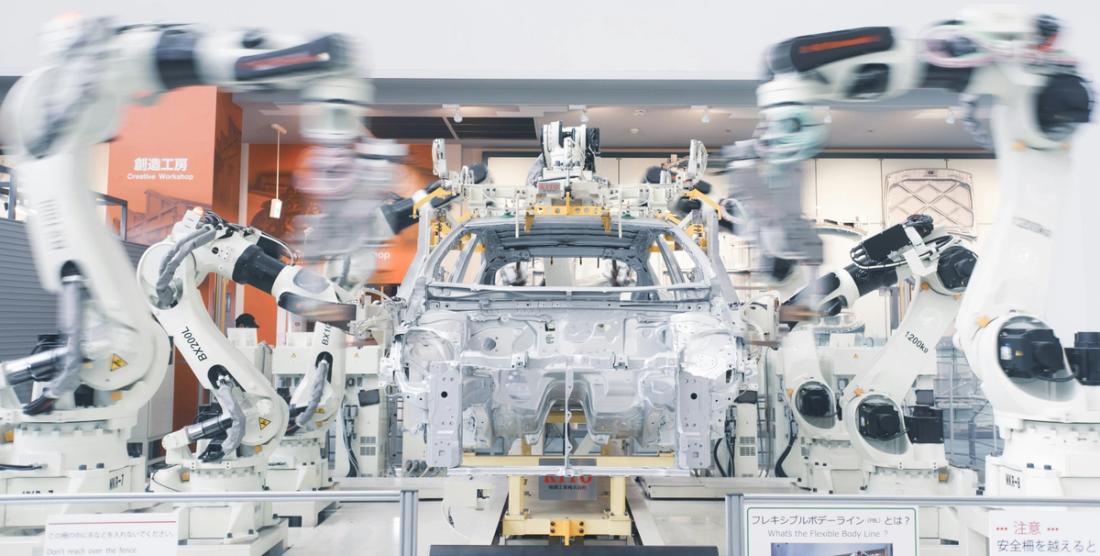
The auto manufacturing industry of the future will not remain a traditional secondary industry that simply "stamps out" vehicles. Global auto and technology experts foresee automakers being completely redefined as "mobility platform and energy solution providers." The vehicle will become a giant home appliance and smartphone on wheels, and the production plant will be transformed into a circular-economy autonomous production system connected in real time to data on clean energy such as solar power and hydrogen.
In the end, the dismantling and restructuring of the traditional auto industry is the clearest evidence of how technological progress can smash the barriers to entry of a 100-year-old industry and open a window of opportunity for new players. Only companies that do not rest on their mechanical-engineering legacy, and that organically combine software and autonomous manufacturing technology to create new value, will survive the fierce storm of this manufacturing transformation and take the lead in the future mobility ecosystem.
© NY&NJ. Unauthorized reproduction and redistribution prohibited.
ⓒ New York and New Jersey. Unauthorized reproduction and redistribution are prohibited.