
Graphic: NY&NJ
In Part 1, NY&NJ found that the AI gap at American universities widens less over who has the tools than over what instructors are set up to teach with them. That design ultimately depends on the instructor in the classroom. At many colleges, the instructors who see the most students are adjuncts, who are the farthest from institutional support.
Same campus, different starting lines
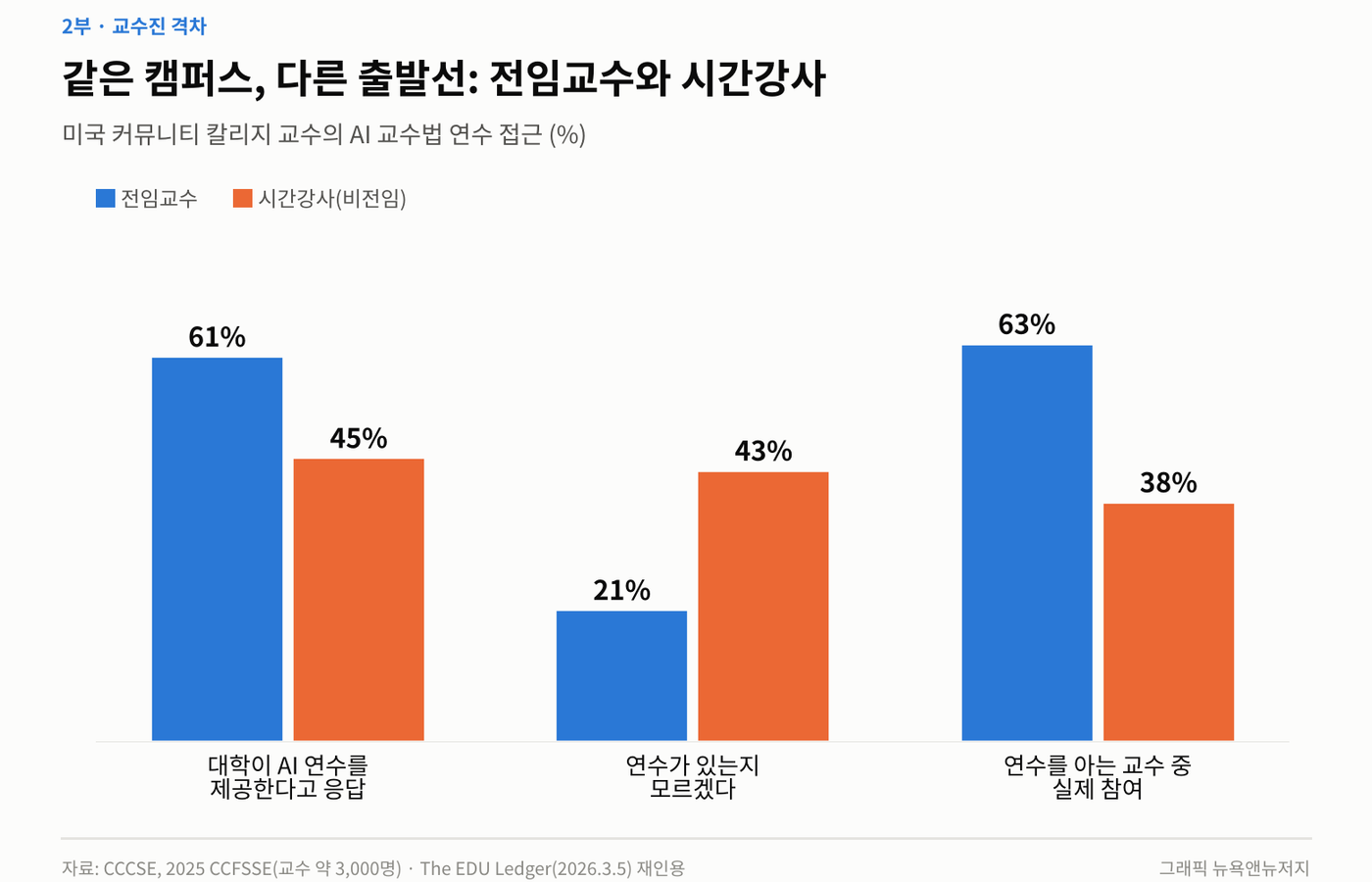
A 2025 survey by the Center for Community College Student Engagement (CCCSE), covering about 70,000 students and about 3,000 faculty members, found that 61% of full-time faculty said their college offers AI teaching training, compared with 45% of adjuncts. Among adjuncts, 43% did not even know whether such training existed, twice the share of full-time faculty. Among those who knew about the training, participation was 63% for full-time faculty versus 38% for adjuncts. Adjuncts are generally paid only for the hours they teach, so time spent on training or course redesign goes uncompensated.
The gap passes down to students. About one-third of students said not one instructor had explained how to use AI. Only 38% said an instructor had taught them how to evaluate AI output.
Back to paper exams
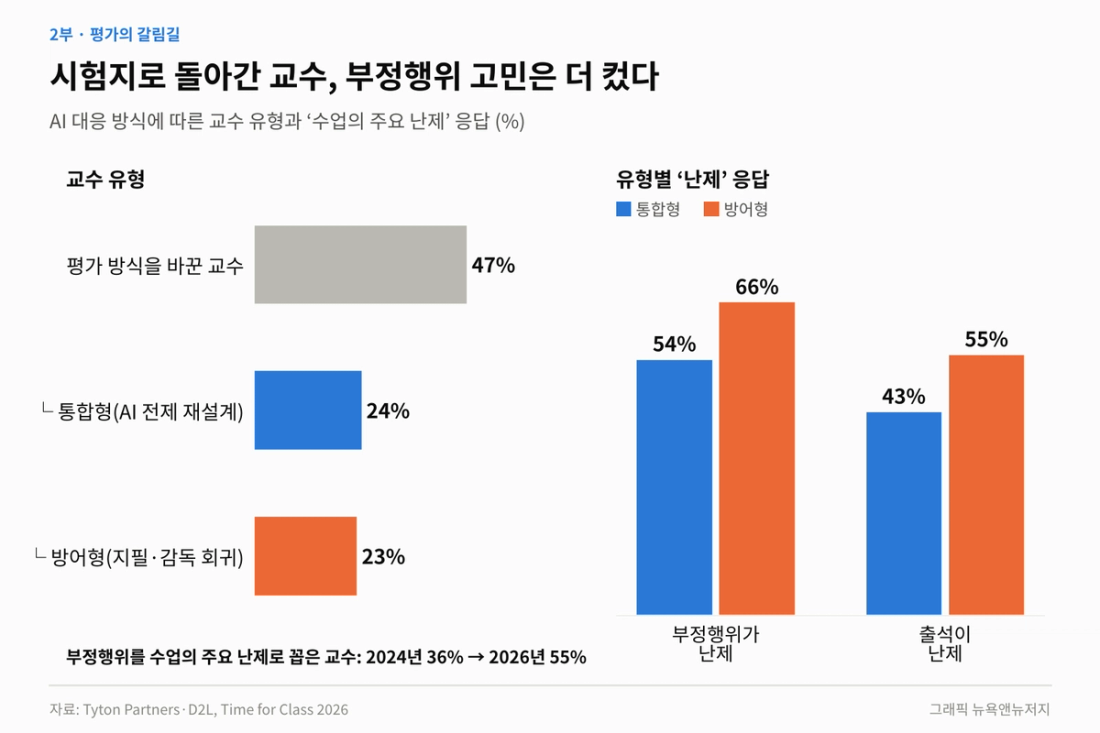
In a Tyton Partners survey, 47% of faculty said they had changed how they assess students because of AI, but they split in opposite directions. Twenty-four percent redesigned assessments with methods such as oral exams and critiques of AI output (the "integrated" group), while 23% went back to paper-and-pencil, proctored exams (the "defensive" group). Defensive instructors (66%) were more likely than integrated ones (54%) to name cheating as a major challenge. Across all faculty, that share rose from 36% in 2024 to 55% this year.
It is hard to blame the defensive group. Giving 300 students a 15-minute oral exam takes 75 hours. The better the assessment, the more instructor time it requires, and a college's finances decide how much of that time is available.
AI detectors are suspicious of non-native speakers
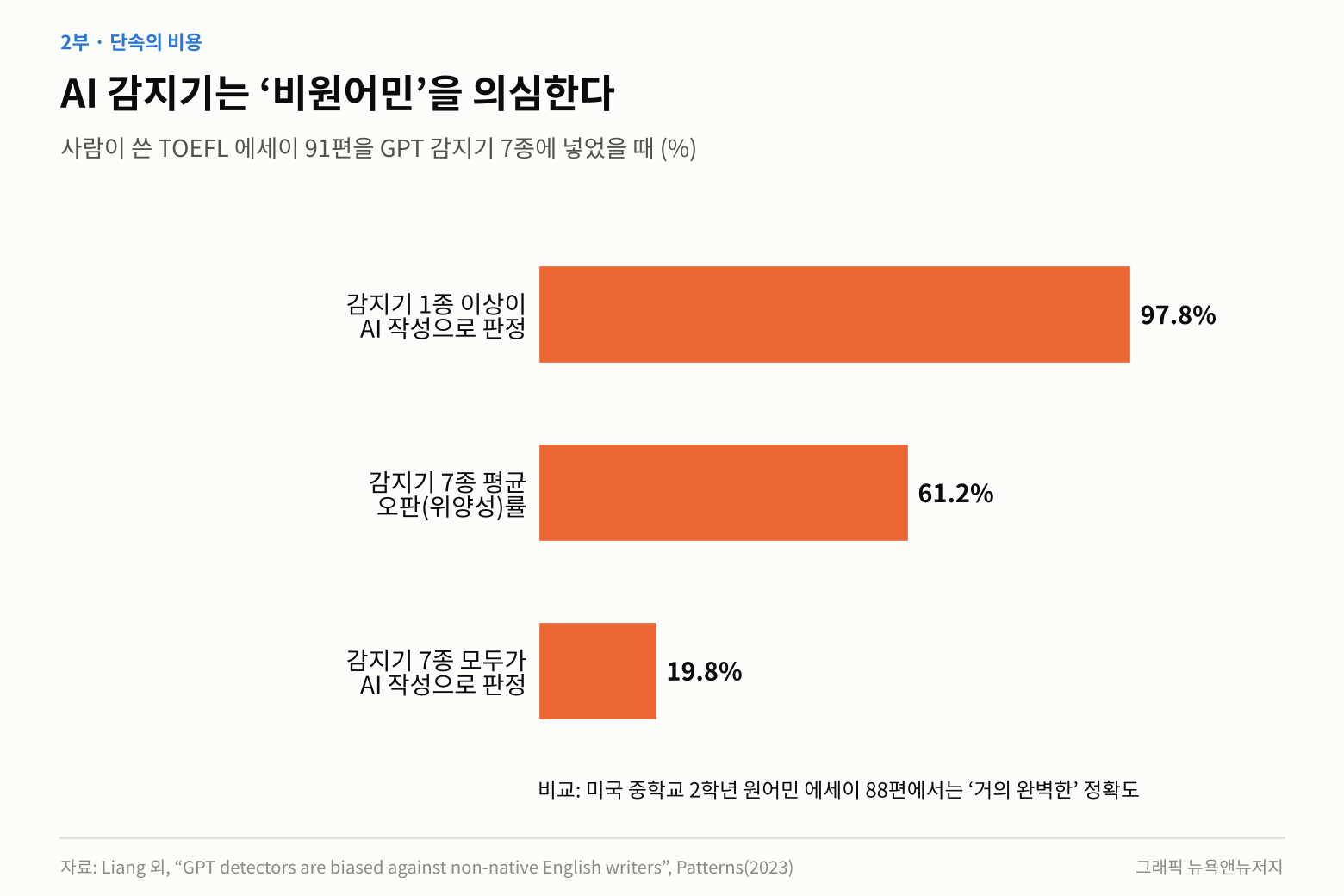
AI detectors are the tool that classrooms without the capacity to redesign lean on. But in a study published in 2023 in the journal Patterns by a Stanford University team, seven detectors misclassified an average of 61% of TOEFL essays written by non-native English speakers as AI-generated. Essays by U.S.-born middle school students were judged with almost no errors. The finding deserves particular attention at colleges in New York and New Jersey, which enroll many immigrants and English learners. Students are advised to keep their drafts and revision histories.
Give people the tools, and the gap narrowed
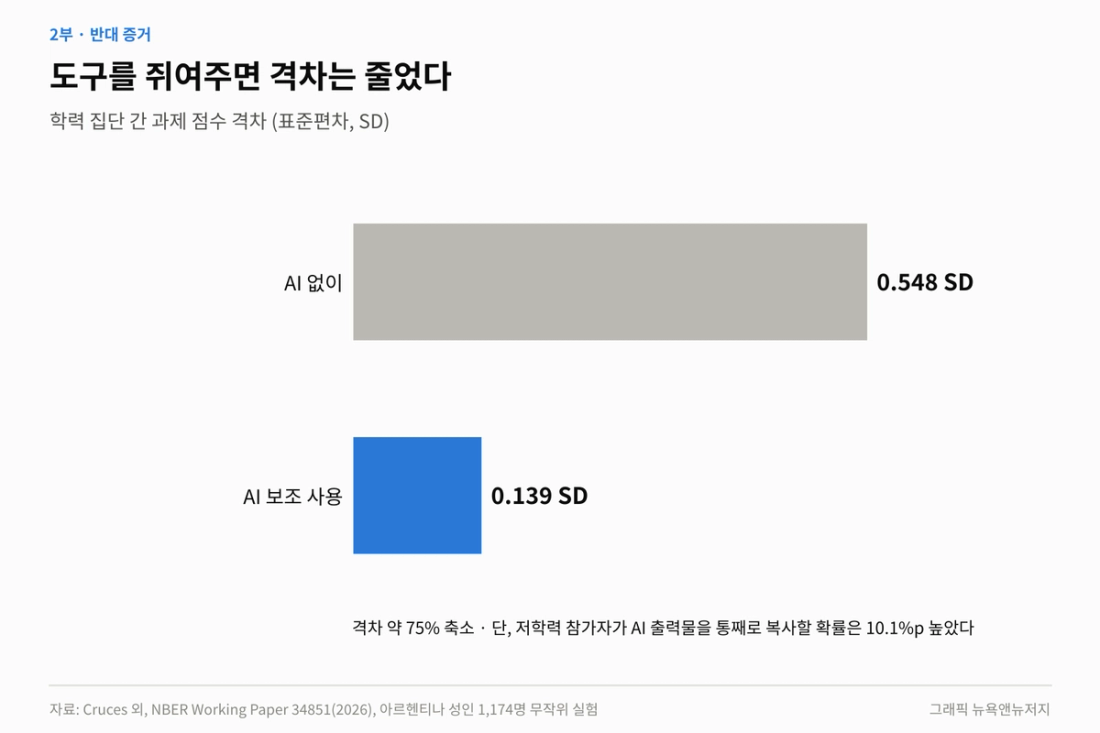
There is also evidence pointing the other way. In a randomized experiment by the National Bureau of Economic Research (NBER), the gap in task scores between adults with different education levels shrank by about 75% when they had AI assistance. However, participants with less education were 10.1 percentage points more likely to copy AI output verbatim, and when they redid the tasks without AI, part of the gap returned. The takeaway is that the gap is set not by the technology but by the conditions people have for learning to use it.
Differences in how people use AI carry over into jobs. A Stanford University team led by Professor Erik Brynjolfsson found that employment of 22- to 25-year-olds fell 13% in relative terms in occupations highly exposed to AI, and that the decline was concentrated in occupations where AI replaces workers rather than assists them.
New York and New Jersey's 'public AI' experiments
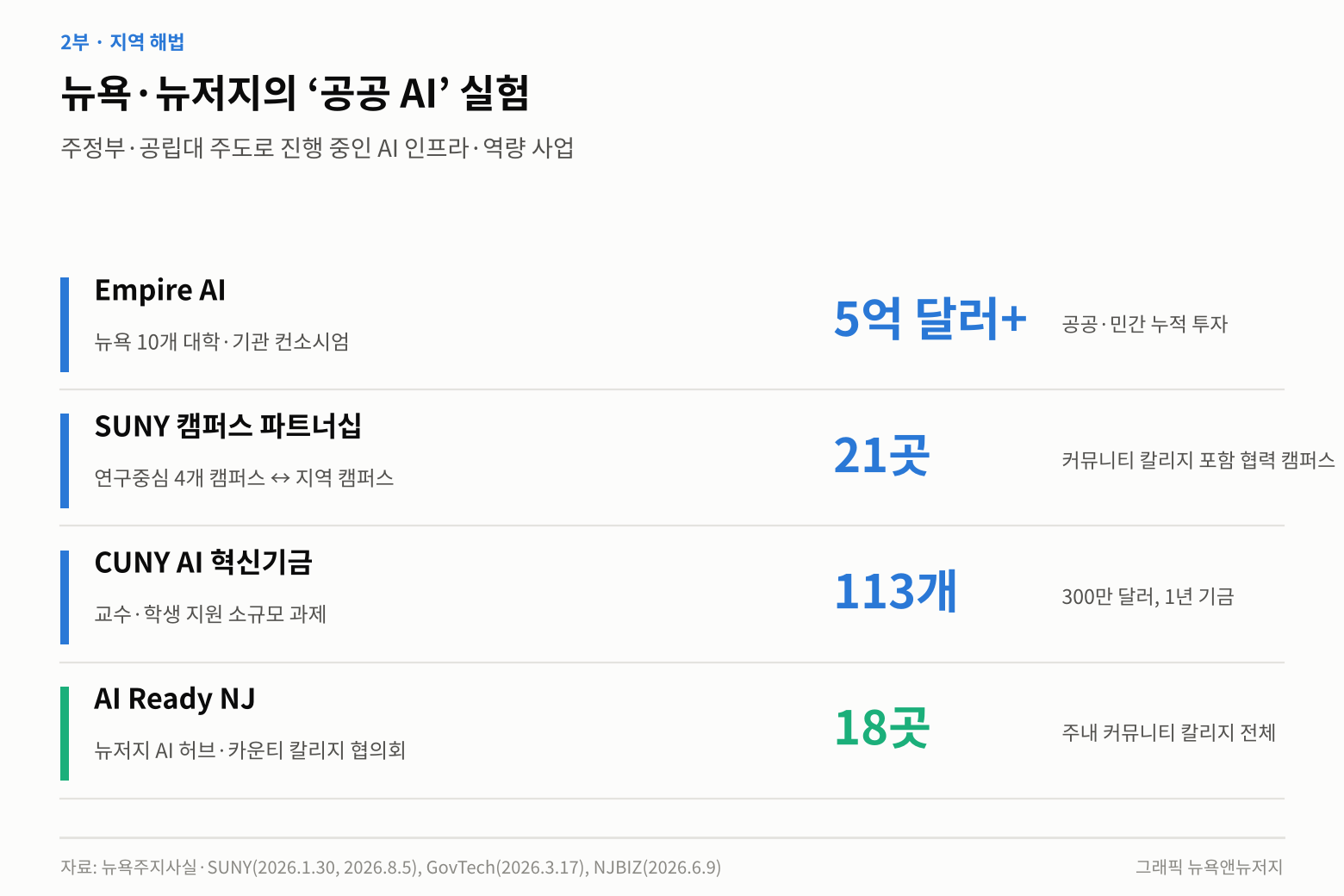
Some are working on solutions. In New York State, Empire AI has 10 institutions, including SUNY, CUNY and Columbia University, jointly own a supercomputer funded with more than $500 million in public and private money. SUNY has launched a partnership linking 21 regional campuses, including research campuses and community colleges, and CUNY is funding 113 AI projects with $3 million. In New Jersey, AI Ready NJ supports faculty training and hands-on student practice at all 18 of the state's community colleges.
The challenge is getting these resources past researchers and into adjuncts' classrooms. Colleges should pay instructors for training time, refrain from disciplining students on a detector's verdict alone, and publish AI data by type of institution. Now that knowledge has moved beyond the walls of the ivory tower, what colleges must protect is the time in which people teach and shape other people.