

[Graphic: NY&NJ]
[Graphic: NY&NJ]
Generative artificial intelligence (AI) is already part of everyday life at American colleges. Six in 10 students use AI for their studies every week, and seven in 10 provosts turn it on for their work every week. But "everyone uses it" does not mean "everyone gets the same thing out of it." NY&NJ cross-checked recent data from leading U.S. higher education research organizations and found that the depth of AI adoption varies sharply with a college's finances and type. The gap was wider at the stage of deciding what to teach with the tools than at the stage of simply having them.
In an essay published last month by the Brookings Institution, Michael J. Ahn, a professor at the University of Massachusetts Boston, argued that as AI takes over the university's role of delivering knowledge, the value of a university is shifting toward "formation," the cultivation of judgment and a sense of responsibility. The problem, he noted, is that formation is expensive education that requires small classes and a lot of faculty time. He warned that this shift will come easily at well-endowed elite universities and with difficulty at regional colleges that depend on tuition.
Access: Nearly everyone uses AI, but not with 'tools the college provided'
In a survey of 1,960 higher education staff members conducted last fall by EDUCAUSE, an association for IT in higher education, 94% had used AI for work. But 56% had used tools their institutions did not provide. The picture is similar on the student side. In an Inside Higher Ed survey of college chief technology officers (CTOs), 27% of institutions provided students with a campuswide AI license, and about half gave them no access at all. The biggest reason was cost.
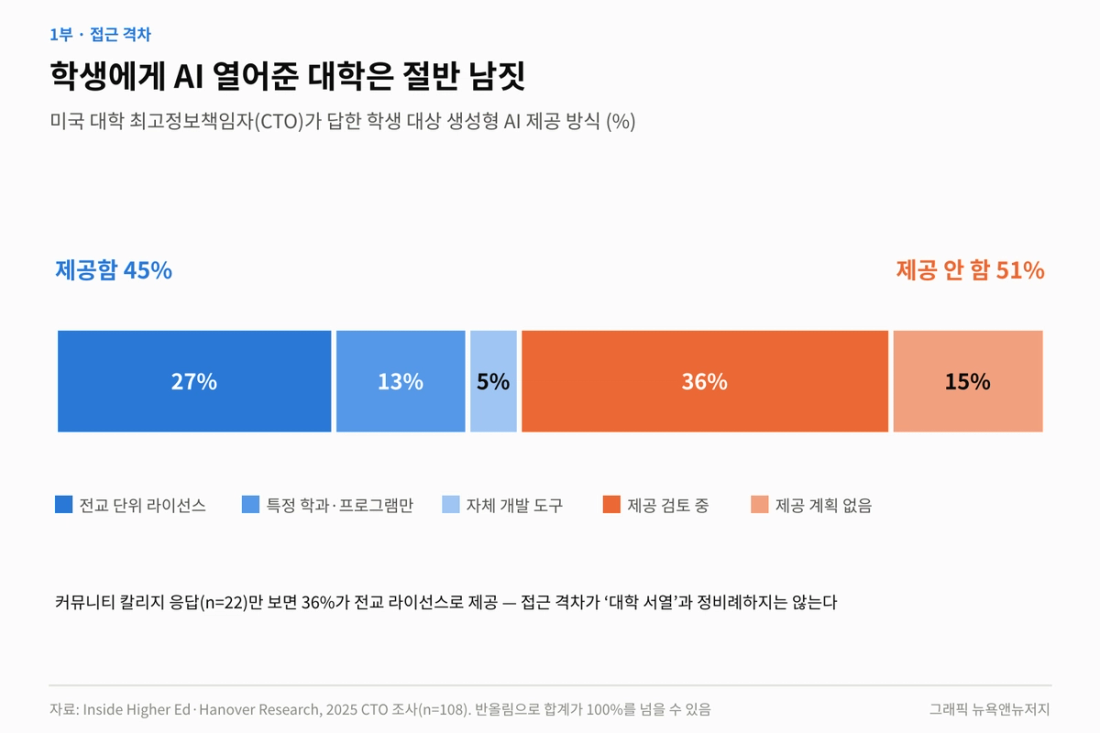
However, the access gap does not line up neatly with institutional prestige. In the same survey, 36% of community colleges provided AI to students through a campuswide license. California State University (CSU) rolled out ChatGPT Edu to all of its more than 470,000 students. The price was steep. The first 18 months cost $17 million, and this year the system renewed a three-year contract at $13 million per year, even as $144 million in budget cuts were under way.
Use: Students are running, faculty are walking
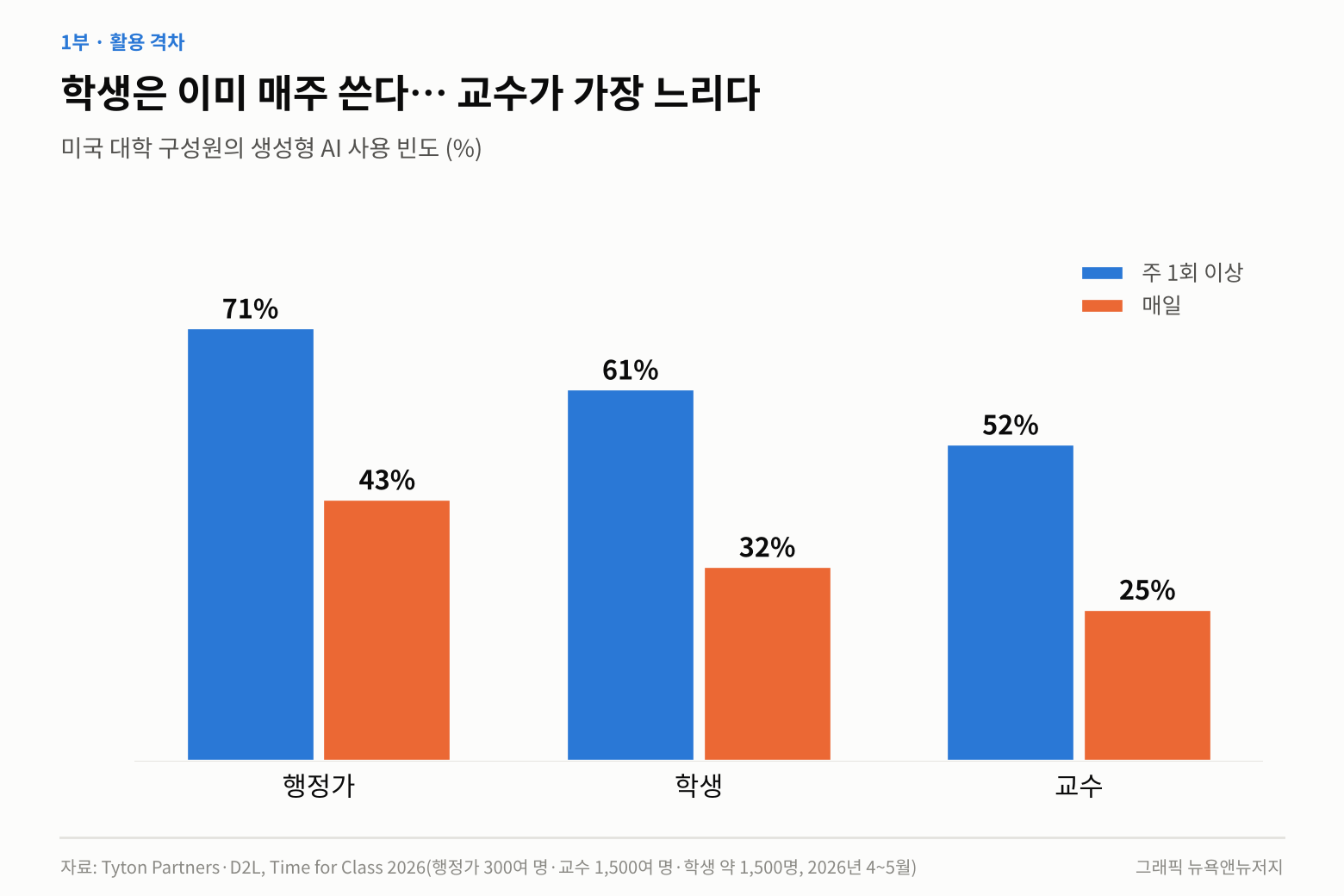
In a survey of more than 3,000 campus community members this spring by education consulting firm Tytton Partners, the shares using AI at least once a week were 71% of administrators, 61% of students and 52% of faculty. The key point is that the faculty who design learning are less familiar with AI than the learners. Whether students use AI to broaden their thinking or to have it write their papers depends to a large extent on how courses and assignments are designed.
No strategy, no money
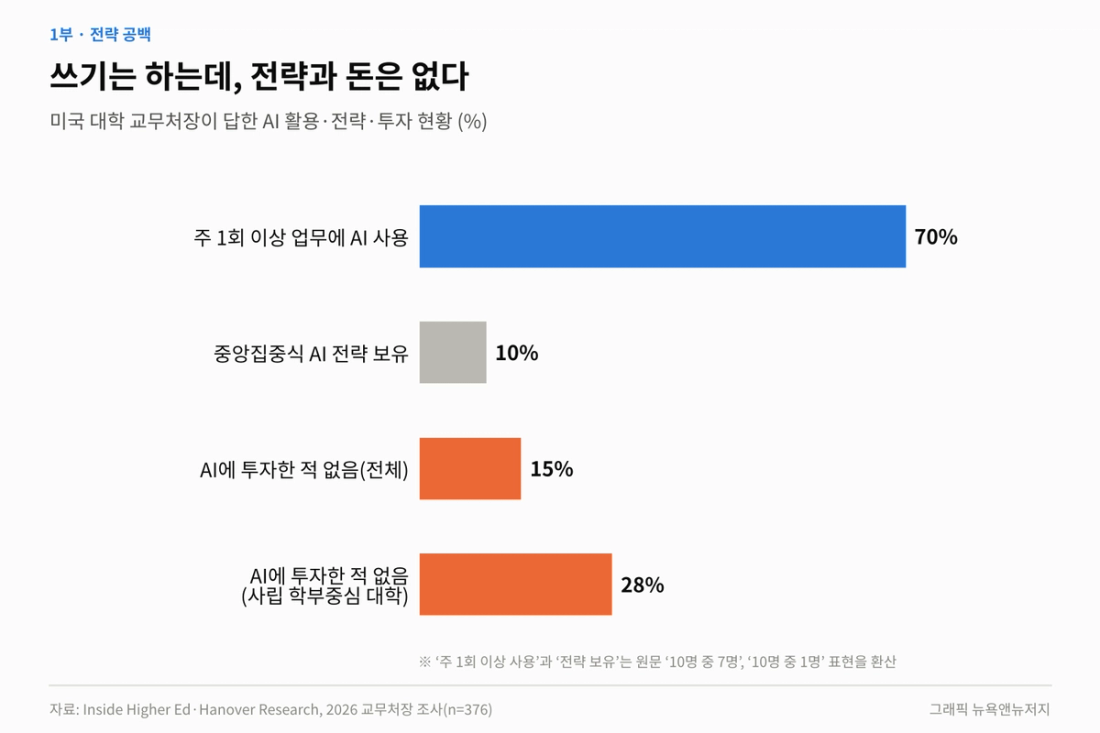
In a survey of 376 provosts conducted by Inside Higher Ed in July and August of this year, only about 1 in 10 institutions had a centralized AI strategy. Fifteen percent had made no investment in AI at all, and that share jumped to 28% at small private bachelor's-focused colleges. Colleges' own use of AI was also concentrated in chatbots (54%) and administrative work. Only 8% said they used it for personalized learning.
[Graphic: NY&NJ]
Curriculum vision differs threefold by type of college
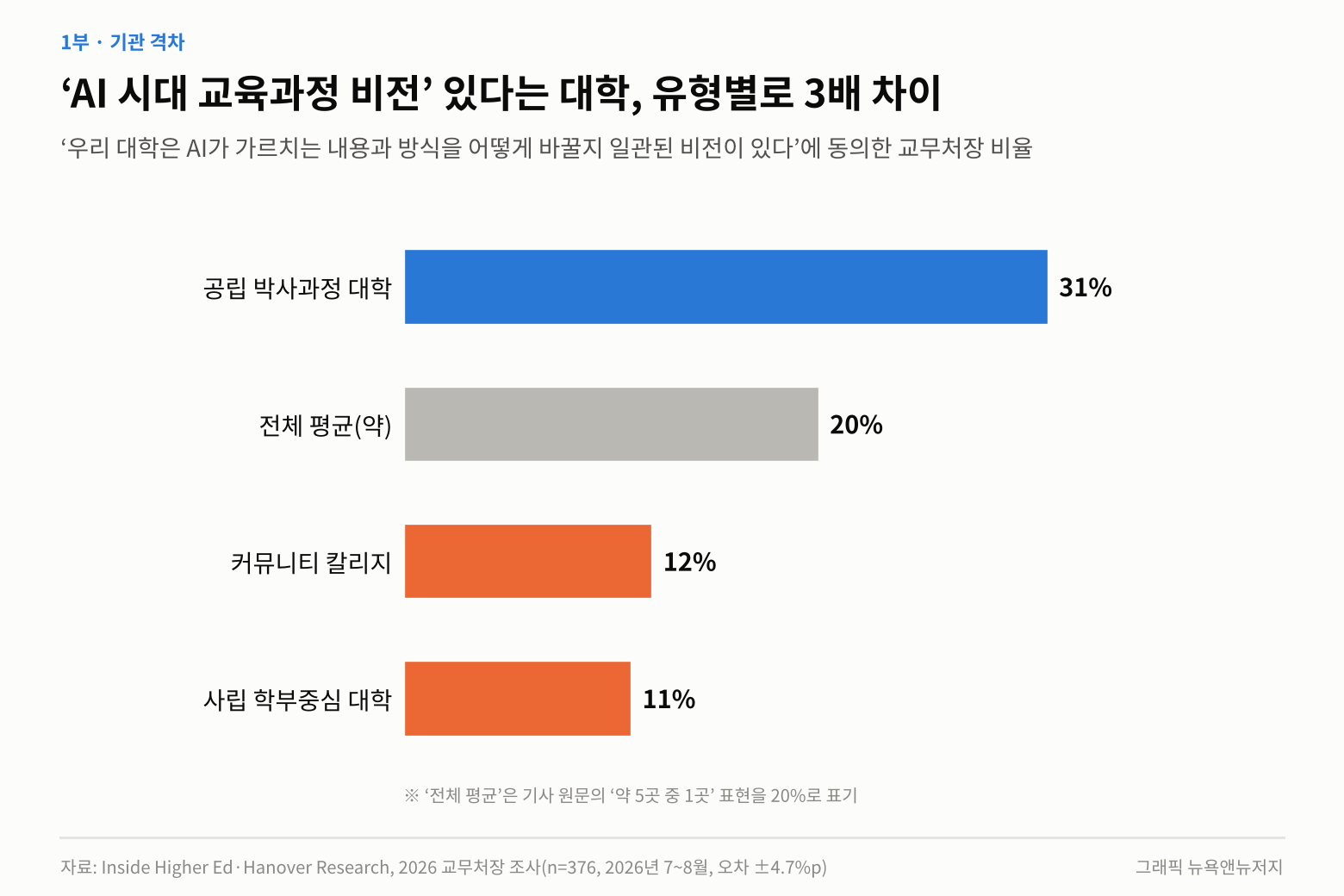
The gap was clearest in the curriculum. The share of provosts who said they have a coherent vision for how AI will change what and how they teach was 31% at public doctoral universities, 12% at community colleges and 11% at private bachelor's-focused colleges. A license can be bought with money, but a vision takes faculty meetings, curriculum overhauls, and people and time to do the work. The barriers provosts cited were also less about cost (about 30%) than about a lack of staff expertise (51%) and faculty resistance (50%).
Responses also varied with institutional heft. Carnegie Mellon University (2018), MIT (2022) and the University of Pennsylvania (2024) created standalone AI degrees. Large public universities compete on scale. Purdue University has made AI competency a graduation requirement beginning with students who enrolled this fall, and Ohio State University and the State University of New York (SUNY) have also built AI into the general education of all undergraduates. Small private colleges and community colleges, by contrast, lag in investment capacity and faculty training.
What has not yet been proven
There are also caveats. The claim that "students at elite universities use AI to extend their thinking while students at lower-ranked schools use it to have papers written" is intuitive, but no large-scale study has directly compared the two. In the course of its reporting, NY&NJ also found cases in which some figures already in circulation were cited differently from the original data. An accurate diagnosis of the gap requires public data broken down by type of college. In Part 2, we will trace the places where this gap is made: the classrooms of adjunct instructors, AI detectors, jobs for new graduates, and the public response in New York and New Jersey.