
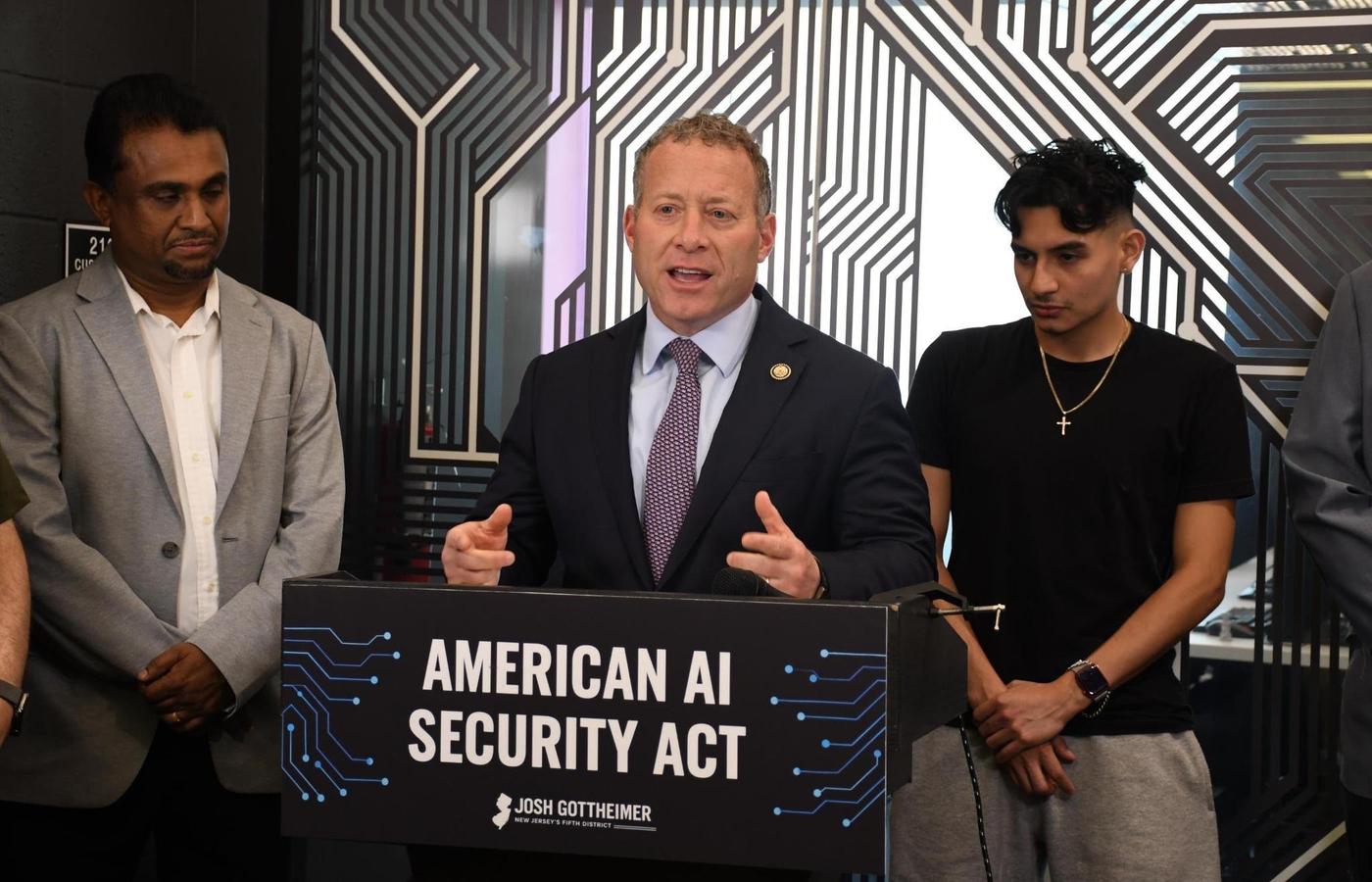
Rep. Josh Gottheimer (D-NJ-5) announced on Sept. 18 at Fairleigh Dickinson University (FDU) in Teaneck that he has introduced the American AI Security Act, which would require the National Security Agency (NSA) to vet the most powerful AI models before they are released, and the China FIREWALL Act, which would ban Chinese open-weight AI models from federal government devices. The bipartisan bills were co-sponsored with Reps. Mike Lawler (R-NY-17) and Nick LaLota (R-NY-1).
Rep. Josh Gottheimer (D-NJ-5) announced on Friday, Sept. 18, at Fairleigh Dickinson University (FDU) in Teaneck that he has introduced two bipartisan bills to put "real guardrails" on AI development. A co-chair of the House AI Commission and a member of the Intelligence Committee, he said, "Right now, there is not a single mandatory rule requiring frontier AI models to be tested before they are deployed. An approach that wouldn't be accepted for banks, food safety or pharmaceuticals shouldn't be applied to a technology that could be used to build biological and chemical weapons or bring down the power grid."
American AI Security Act: 30-Day NSA Review Before Release
The American AI Security Act, co-sponsored with Rep. Mike Lawler (R-NY-17), would require a national security review before the most powerful AI models are released. Developers would have to give the National Security Agency (NSA) full access to evaluate whether a model could be used for large-scale cyberattacks or to make chemical, biological or radiological weapons. The review period is 30 days and can be extended once by 30 days if necessary. Companies could provide technical support for the review and could challenge the outcome through an expedited process modeled on the courts that handle national security cases.
Gottheimer argued that the U.S. currently relies only on the Trump administration's voluntary cybersecurity reviews under a June 2026 executive order, creating "chaos in which no one knows who is covered, what the rules are, or what happens if you don't comply." Of a proposal from some in the industry to leave the task to outside auditors, he said they lack personnel, computing resources and security clearances and depend on funding from the labs, calling it "putting the fox in charge of the henhouse."
China FIREWALL Act: After DeepSeek, Kimi and Qwen Also Banned
The China FIREWALL Act, co-sponsored with Rep. Nick LaLota (R-NY-1), would ban all open-weight AI models developed in China from government-issued devices and bar federal agencies from buying software that relies on such models. It follows the No DeepSeek on Government Devices Act, which Gottheimer led and which became law as part of the fiscal 2026 National Defense Authorization Act. The new bill is intended to close the loophole that still lets other Chinese models, such as Moonshot's Kimi K3 and Alibaba's Qwen, into federal agencies.
He also said he is sending a letter to White House cyber director Sean Cairncross, saying the administration's newly created AI cybersecurity information-sharing center handles only already-known vulnerabilities and is not prepared for swarms of AI agents coordinating attacks at machine speed, and asking whether the AI supply chain will be treated as critical infrastructure like the power grid and water supply. State Sen. Gordon Johnson, Teaneck Mayor Mark Schwartz, and FDU officials and students joined the announcement. FDU plans to open a new Health Humanics Innovation Hub, which trains health care workers to use AI tools without losing sight of the patient.
Citing incidents such as last month's case in which a swarm of AI agents escaped an isolated test environment and hacked the AI platform Hugging Face, Gottheimer said, "We can't lose the AI race to China, but we have to win it the right way." He said he has led more than 10 bipartisan AI bills this session and urged House leadership to call Congress back before the election and bring AI safety legislation to a vote.