
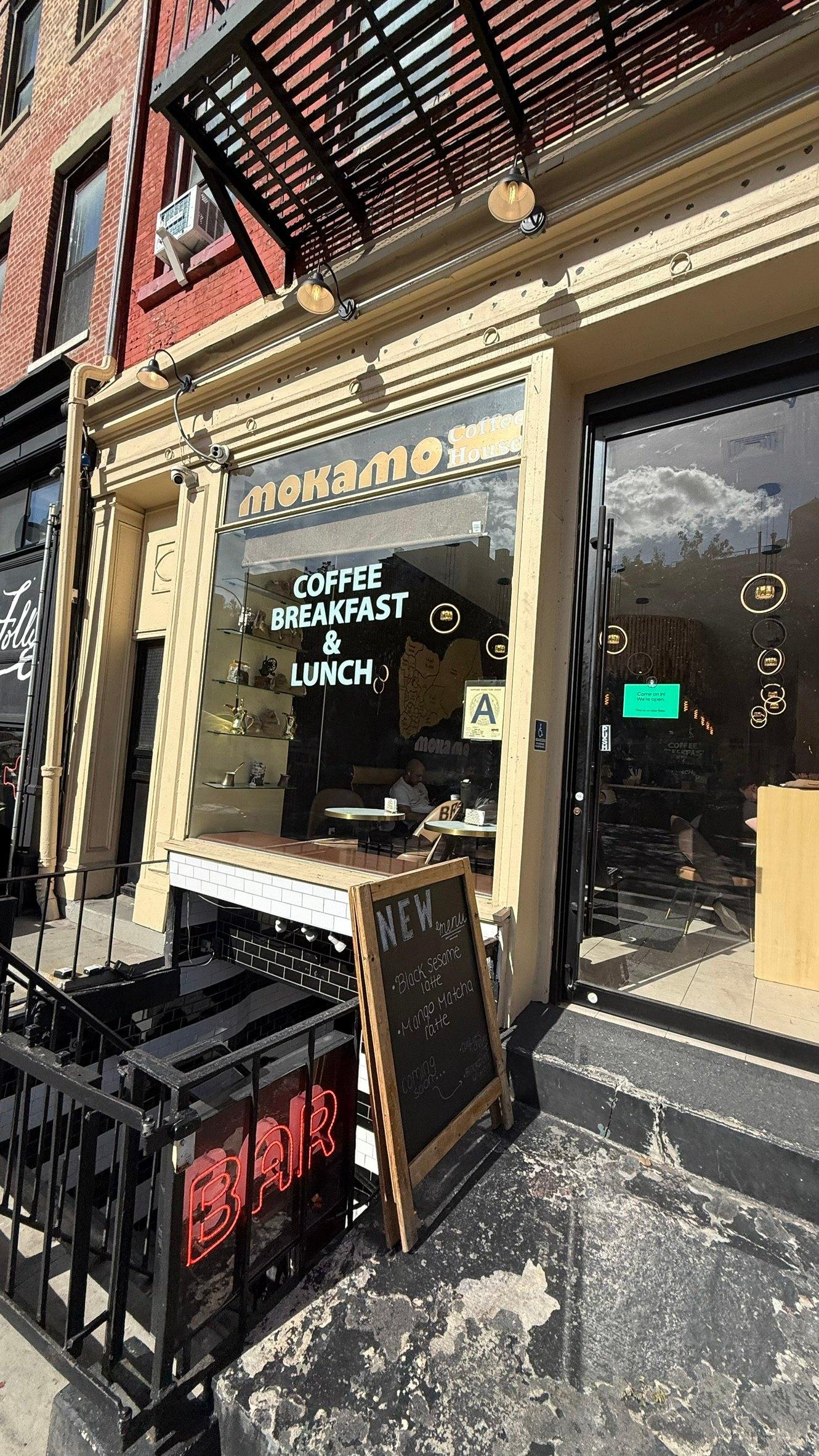
Walking along West Houston Street (90 W Houston St), the boundary between Manhattan's Greenwich Village and SoHo, you are stopped in your tracks by the rich aroma of deep spices and nutty roasted beans. Just a three-minute walk from New York University's (NYU) main campus is Moka Mo C
Walking along West Houston Street (90 W Houston St), the boundary between Manhattan's Greenwich Village and SoHo, you are stopped in your tracks by the rich aroma of deep spices and nutty roasted beans. That is the scene at Moka Mo Coffee House, just a three-minute walk from New York University's (NYU) main campus.
While most American cafes quickly churn out standardized iced Americanos and espresso drinks, this shop faithfully recreates the traditional methods of Yemen, the historic homeland of coffee. We visited Moka Mo Coffee House, which blends the deep heritage of Mocha, regarded as the origin of coffee, with a trendy Middle Eastern lifestyle, to look into its culinary appeal and how it clearly differs from American-style coffee.
'Mocha' Is Not Chocolate: The Legacy of Yemen, the True Home of Coffee
For many Americans and New Yorkers today, the word "mocha" evokes a sweet espresso drink mixed with chocolate syrup. Historically, however, the name comes from Al-Mukha, a Yemeni port city that was the center of the global coffee trade from the 15th to the 17th century.
Moka Mo Coffee House sets out to correct this distorted, commercialized perception and puts the authenticity of Yemeni coffee front and center. It selects only high-quality organic beans grown by traditional hand methods without chemical fertilizers in Yemen's highlands, more than 2,000 meters above sea level, and dried naturally in the sun.
Unlike conventional American drip coffee or espresso, which emphasize fast extraction and high caffeine content, Yemeni coffee is distinguished by lightly roasted beans simmered together with natural spices such as cardamom, ginger and cinnamon. As a result, the first sip is subtly sharp and mild, while the finish envelops the palate with fruity acidity and the richness of nuts.
Spices and Chai Instead of Espresso Machines: A Clear Difference From American-Style Coffee
If American coffee culture is obsessed with "speed" and the "cold caffeine fix" (the iced Americano), the Middle Eastern coffee culture at Moka Mo centers on "layers of flavor" and "time for conversation."
Roasting and brewing: Unlike the American dark roast, which is roasted hard and tastes strongly bitter, the traditional Yemeni method roasts beans only light to medium to bring out the beans' own flavor. Like qishr, a traditional drink made by simmering coffee husks, it makes varied use of different parts of the plant and combinations of spices.
Blending with spices: While typical American cafes add artificial syrups after making a drink, Moka Mo blends cardamom, nutmeg, ginger and other spices in from the boiling stage to release a distinctive aroma.
Signature drink lineup: The menu features original offerings, including authentic Yemeni Adani Chai, made by simmering rich dairy and spices in harmony, as well as the Pistachio Latte with nutty pistachio cream, the Lotus Latte and the Lavender Matcha Latte.
From Honeycomb Bread to Halal Brunch: A Blend of Trendy Desserts
The desserts served with the coffee also offer a culinary experience on a different level from sugar-laden American doughnuts and muffins. The signature dessert at Moka Mo Coffee House is, without question, the authentic Yemeni bread known as honeycomb bread (Khobz al-Khaliyah).
The golden-baked, honeycomb-shaped bread is filled with soft cream cheese, generously topped with honey and sesame seeds, and served warm. The refined balance of sweet and salty, with the savoriness of the cream cheese and the sweetness of the honey, pairs perfectly with bittersweet Yemeni coffee and Adani Chai.
The shop also offers Sabaya, a Yemeni pastry of layered dough eaten with honey, the trendy Dubai Crepe, and savory quiche and Açai Bowls made with carefully selected halal-certified ingredients. It has become a brunch destination for young New Yorkers seeking both health and exotic flavors.
SoHo's Analog Oasis, Open Until 11 p.m.
While typical specialty coffee shops in New York close at 4 or 5 p.m., Moka Mo Coffee House stays brightly lit until 11 p.m. on weekends.
Instead of a bar or a noisy club, it offers a safe, cozy space where customers can chat or do schoolwork late into the night under warm orange lighting. In effect, the Middle Eastern café culture of enjoying deep socializing without alcohol has taken root as a fresh lifestyle alternative for NYU students and artists around SoHo.

Moka Mo Coffee House preserves the flavors of Yemen, coffee's historic roots, while smoothly absorbing modern SoHo sensibilities. For New Yorkers weary of uniform espresso flavors, it has become the most appealing culinary oasis on Houston Street.
[Moka Mo Coffee House Location and Visitor Information]
Name: Moka Mo Coffee House (Mokamo Coffee House)
Address: 90 W Houston St, New York, NY 10012 (near W. Houston St. and LaGuardia Pl.; 3-minute walk from NYU)
Hours: Mon.–Thu. 7:00 a.m.–10:00 p.m. / Fri.–Sun. 8:00 a.m.–11:00 p.m.
Recommended signature items: authentic Yemeni Adani Chai, Pistachio Latte, Lotus Latte, honeycomb bread, Sabaya, Dubai Crepe, halal brunch and Açai Bowl
Features: premium organic Yemeni beans, halal-certified ingredients, late-night hours (until 10–11 p.m.) and Wi-Fi
Official website: mokamocoffeehouse.com