
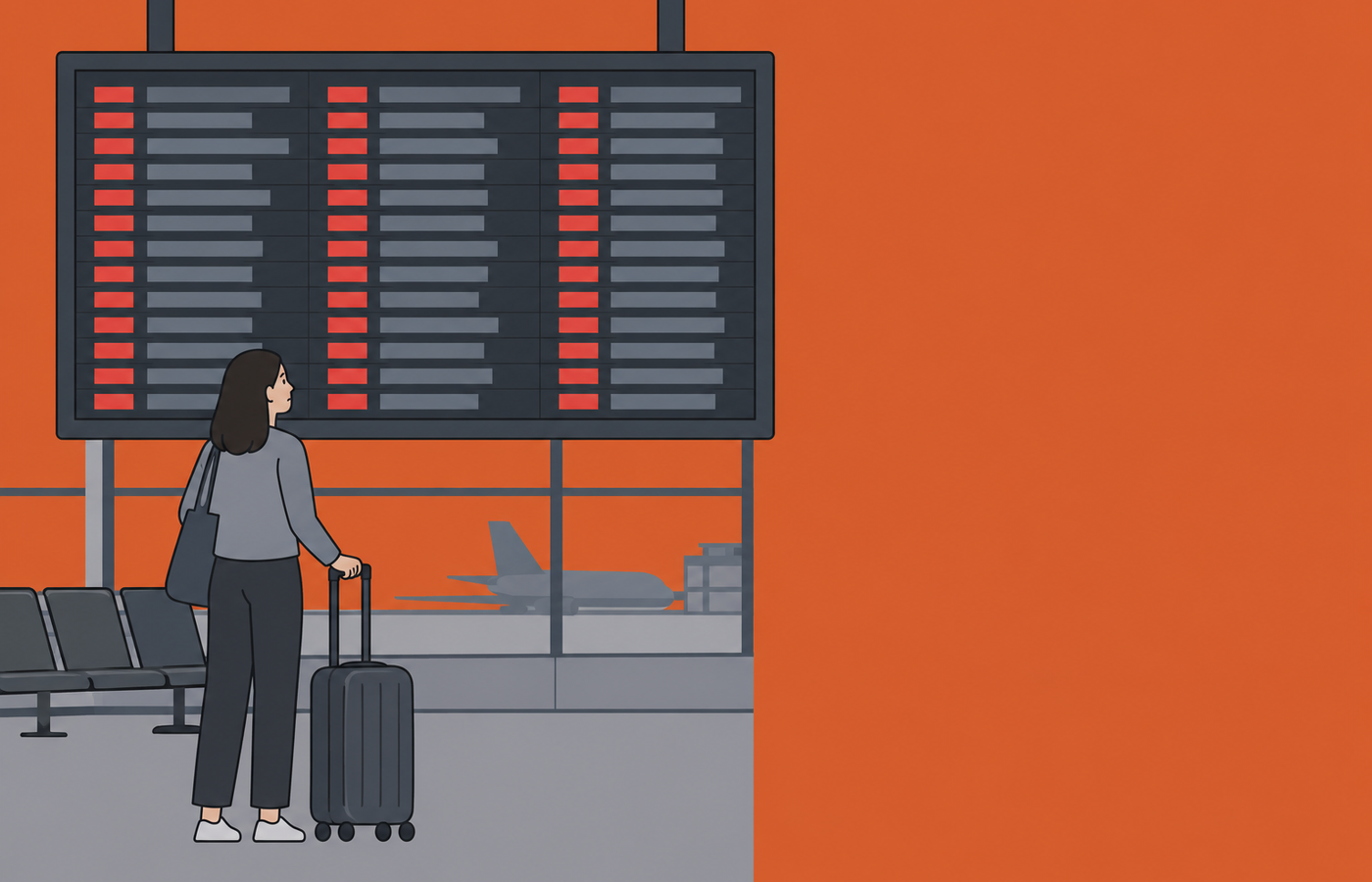
Transportation Secretary Sean Duffy pointed to "outdated analog communications equipment" as the cause of the Federal Aviation Administration (FAA) ground stop that halted flight departures across the U.S. for 4 hours and 20 minutes on Friday, Nov. 13. He explained that a surge of data overloaded old switches and routers, causing radar and communications information to conflict. More than 4,000 flights were canceled on Nov. 13, and disruptions continued on Saturday, Nov. 14, with nearly 2,000 flights canceled nationwide.
Transportation Secretary Sean Duffy has blamed "outdated analog equipment" for the FAA's nationwide ground stop, which shut down the nation's skies for more than four hours. At a White House briefing on the night of Friday, Nov. 13, Duffy said, "We have an air traffic control system that is unbelievably old," adding, "It runs on an analog communications network." Meanwhile, more than 4,000 flights were canceled on Nov. 13, and cancellations and delays continued at airports nationwide on Saturday, Nov. 14.
At a Glance
"1980s Copper Wire… Routers Were Crushed by Data"
According to ABC News and Fox Business, Duffy explained that starting around 3:30 p.m. on Nov. 13, radar and communications became unstable at regional Air Route Traffic Control Centers (ARTCC) and Terminal Radar Approach Control facilities (TRACON) near airports. "Our switches and routers were overloaded with data, and the data coming out of those routers started to conflict," he said. "So we stopped the system." He said that when aircraft positions displayed on controllers' screens no longer matched communications information, flights about to take off were stopped first for safety.
Duffy spoke directly about how old the equipment is. "We use old, old switches and routers, thin copper wire from the 1980s," he said. He added that the equipment that failed this time was also "old legacy equipment," and warned that "it will keep breaking down." By contrast, he stressed that the same problem did not occur with recently installed new equipment.
When the ground stop was issued, about 3,500 aircraft were in U.S. skies. "The systems in place kept everyone safe, and all aircraft landed," Duffy said. "We identified what went wrong, turned the system back on and resumed operations." The FAA halted departures at airports nationwide at 3:54 p.m. and lifted the ground stop at 8:15 p.m. This was the second nationwide ground stop since the Sept. 11, 2001, terrorist attacks; the earlier one came in January 2023, when the Notice to Air Missions (NOTAM) system went down.
"We Need $50 Billion in Emergency Funding"
Duffy spent most of the briefing pressing for funding. "This is an emergency," he said. "I want Congress to provide emergency funding. We need $50 billion." He said the money would go toward a "complete replacement" of control equipment, communications networks and control towers. He said it is better to build an entirely new system than to keep patching the old one, calling it "a bipartisan issue and an American issue."
According to Reuters, Congress approved $12.5 billion over five years last year to upgrade the air traffic control system. In April, the FAA signed a contract worth about $5 billion with the U.S. arm of German communications equipment maker Rohde & Schwarz to replace up to 462 old voice communications switches. According to the aviation publication Flying, more than 40 new switches have been installed so far. Federal officials said about half of the old copper lines that carry radar and communications data have been replaced with new lines.
Conflicting Accounts of the Cause
The cause has not been fully pinned down. Homeland Security Secretary Markwayne Mullin, asked about the possibility of a cyberattack, said, "Nothing is completely certain yet, but it doesn't appear that way." He said officials are also looking into compatibility problems between the old equipment and the new technology being installed. Citing sources, CBS News reported that reboots and outages continued as the communications network linking the control systems was being updated. CNN reported that some air traffic controllers do not fully accept Duffy's explanation.
Airspace Intel, maker of the artificial intelligence air traffic control assistance system "SMART" that is being introduced at control facilities, said the ground stop had nothing to do with its system. Duffy also said, "What broke was old legacy equipment," and that there was no possibility SMART had played a role. In Congress, House Democratic Leader Hakeem Jeffries called it an "unprecedented breakdown" and demanded an explanation. Sen. Tammy Duckworth, ranking Democrat on the Senate aviation subcommittee, and Sen. Maria Cantwell, ranking Democrat on the Senate Commerce Committee, also said they would demand answers from the FAA.
Cancellations Continue Nov. 14… What About New York Airports?
According to PIX11, more than 4,000 flights to, from and within the U.S. were canceled on Nov. 13, and delays approached 10,000. In the New York area, FlightRadar24 counted 155 canceled flights at JFK, 142 at LaGuardia and 48 at Newark on Nov. 13. At one point, 41% of all flights at LaGuardia were canceled. A nor'easter added to the problems in the morning.
The fallout lasted into Nov. 14. According to ABC7 New York, nearly 2,000 flights were canceled nationwide on the morning of Nov. 14. At LaGuardia, 50 flights were canceled in the morning alone and about 14% of scheduled flights were delayed, an improvement from the day before. Duffy said, "It will take time to unwind what happened this afternoon," adding that delays and cancellations will continue while airlines rebuild their schedules and reposition aircraft and crews. He added that he expects operations to return to normal before the Thanksgiving travel rush.
What Passengers Should Know
Passengers flying this weekend should check their flight status again on the airline's app or website before leaving for the airport. If a flight is canceled, travelers can switch to another flight or request a refund through the app. Under U.S. Department of Transportation rules, if an airline cancels a flight and the passenger does not accept an alternative, the passenger is entitled to a cash refund. Delays at each airport can be checked on the FAA's National Airspace System Status page (nasstatus.faa.gov). Passengers flying to or from Korea may also face delays on connecting U.S. domestic flights, so it is safest to check directly with the airline.
The FAA and the Department of Transportation are continuing to investigate exactly how the outage occurred. NY&NJ will follow up as the results of the investigation become available.