
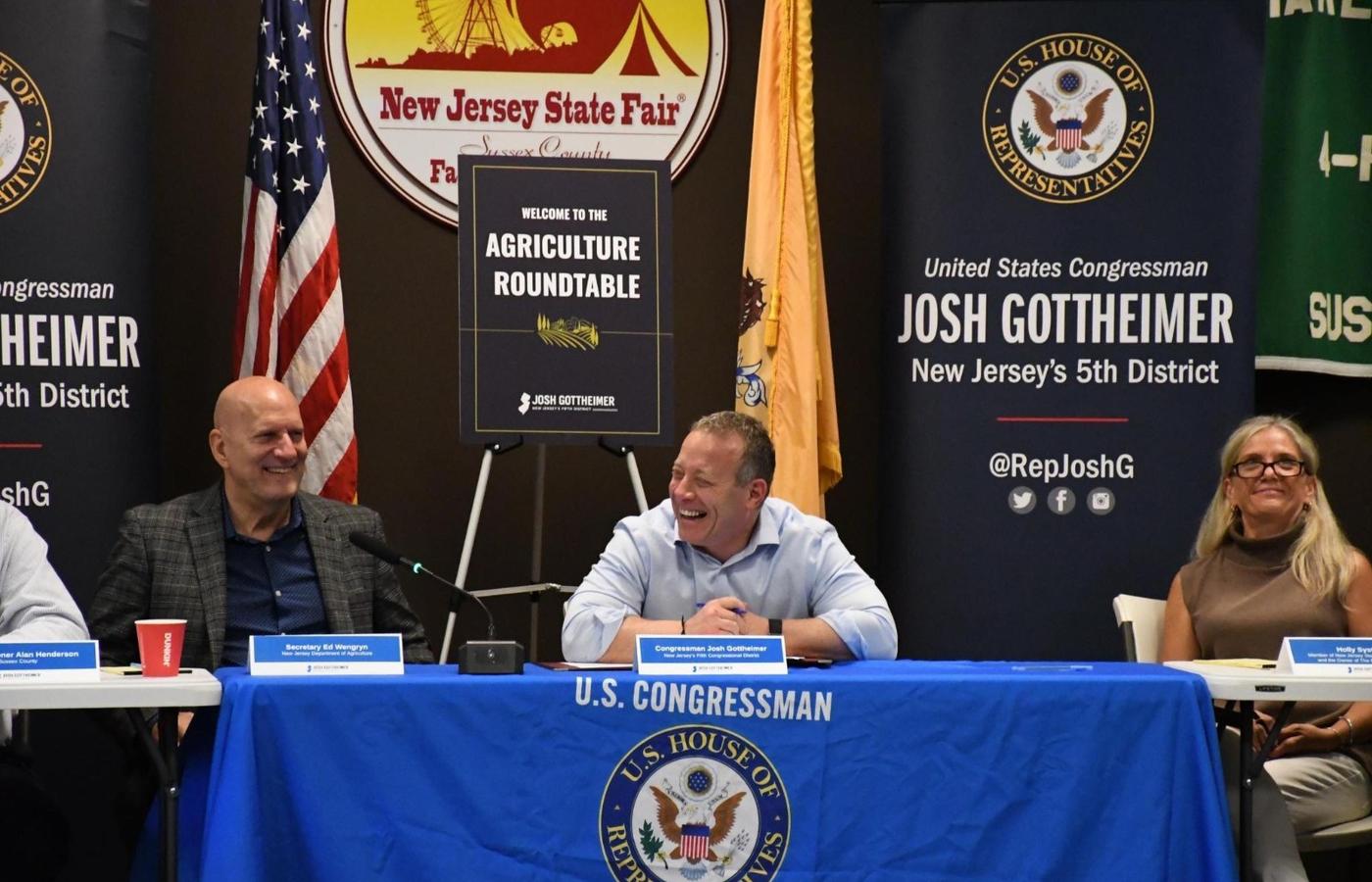
Rep. Josh Gottheimer (D-NJ-5) held a farmers roundtable in Augusta, Sussex County, saying the April freeze caused about $300 million in losses to fruit and berry growers in 13 states, including New Jersey. He introduced the 'FROST Relief Act,' which would provide block grants to affected farms, and the 'TEMP Act,' which would create temperature-based crop insurance. He also said the SNAP provision in the farm bill, which has only been extended repeatedly since 2018, would impose a cost of $200 million a year on New Jersey, and urged the Senate to amend it.
Rep. Josh Gottheimer (D-N.J.'s 5th Congressional District) held a roundtable with farmers from the 5th District in Augusta, Sussex County, on Oct. 8, where he heard pleas that rising diesel, fertilizer and equipment prices, tariffs, low milk prices and damage from the April freeze have pushed family farms to the brink. The 5th District is home to more than 1,000 farms.
According to Gottheimer's office, a severe freeze struck in April, when trees were blooming and budding, and fruit and berry growers growing peaches, cherries, apples, strawberries and blueberries lost a significant portion of their harvest. Damage is estimated at about $300 million. New Jersey is one of the nation's top 10 specialty crop states, but current crop insurance is poorly suited to specialty crop risks such as freezes, and many farmers received no compensation, the office said.
The FROST Relief Act and the TEMP Act
At the roundtable, Gottheimer announced he had introduced the 'FROST Relief Act (Farmer Recovery Opportunity and Support for Temperatures Relief Act).' It would provide block grants to the 13 states that experienced the April freeze — New Jersey, New York, Pennsylvania, Connecticut, Massachusetts, Maryland, Delaware, Virginia, West Virginia, Ohio, Indiana, Illinois and Michigan — and allow state governments to support affected farms directly, without complicated procedures. The 'TEMP Act,' introduced alongside it, directs federal crop insurance to develop an affordable, temperature-based insurance product for specialty crop farmers.
Farm Bill: "SNAP Provision Would Cost New Jersey $200 Million a Year"
He also laid out priorities for the final version of the Farm Bill, which was last enacted in 2018 and has only been extended since. Gottheimer argues that the House-passed version would require states to pay 5% of Supplemental Nutrition Assistance Program (SNAP, or food stamp) benefits and increase their share of administrative costs, imposing up to $200 million in new costs on New Jersey taxpayers each year. He said that when families lose SNAP eligibility, their children also lose automatic eligibility for free school meals, and he called on the Senate to amend the bill. He also said he had introduced the 'Feed Our Kids Act,' which would provide free meals to all students and have schools buy local farm products.
His other priorities include an amendment raising the population cap in the U.S. Department of Agriculture's definition of "rural" from 20,000 to 50,000 so that northern New Jersey areas can also receive broadband and infrastructure support; lifting the hiring freeze at the Farm Service Agency (FSA); restoring more than $1 billion in cuts the federal government made to local farm product purchasing and school meal support (he said New Jersey lost $26 million that would have gone to 46 farms and food businesses, including 11 in the 5th District); expanding specialty crop block grants; controlling invasive pests such as the spotted lanternfly; investing in meat processing facilities; and expanding rural broadband. A bill allowing whole milk in schools, pursued at the request of dairy farmers, became law in January.
Attendees included New Jersey Agriculture Secretary Ed Wengryn, state Sen. Parker Space, Sussex County commissioners, representatives of the New Jersey Farm Bureau and agricultural associations, officials from the U.S. Department of Agriculture's New Jersey Farm Service Agency, dairy, beef and grain farmers, and 4-H coordinators. Gottheimer also pledged support for youth agricultural education during National 4-H Week, the first week of October.