
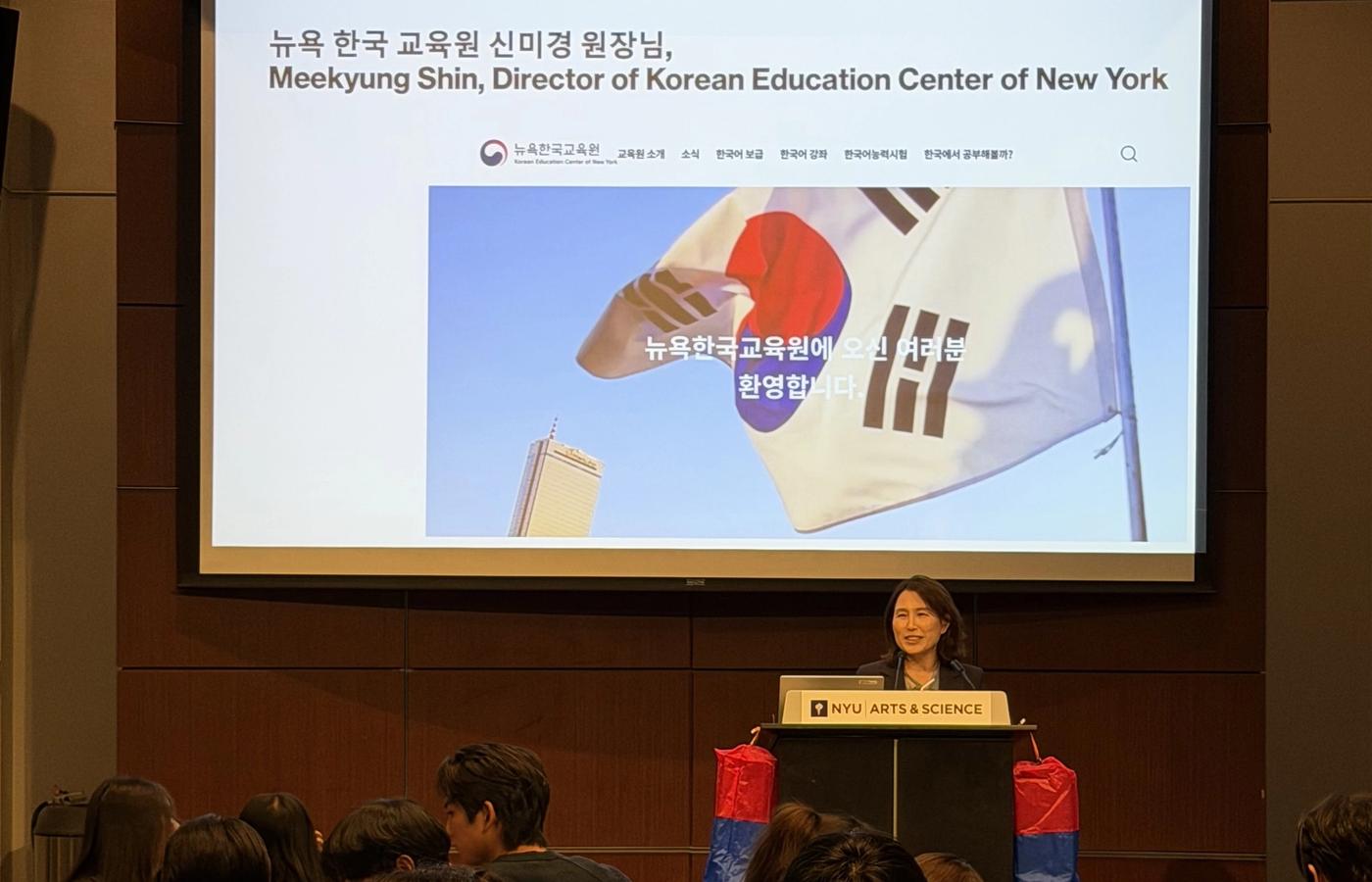
The Korean Education Center in New York introduced students to the meaning behind the creation of Hangul and the history of Korea's educational development at a Hangul Day event hosted by New York University's Department of East Asian Studies on Thursday, Oct. 22. In her congratulatory remarks, Director Shin Mi-kyung said that Korea, "one of the poorest countries in the world right after the Korean War, decided to send every child to school," and that investment in education is the force that built today's Korea. The event also featured calligraphy, jegichagi, yutnori and hanbok experiences. About 200 students are studying Korean at NYU.
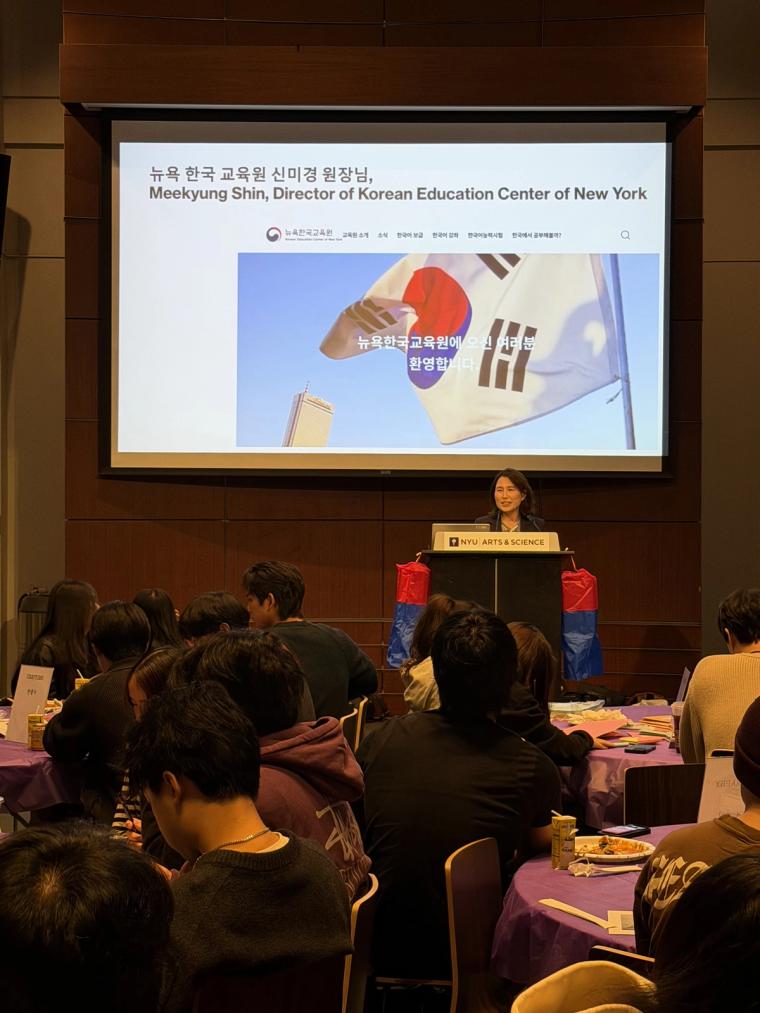
The Korean Education Center in New York (Director Shin Mi-kyung) took part in a Hangul Day event hosted by New York University's Department of East Asian Studies on Thursday, Oct. 22, telling students about the meaning of the creation of Hangul and the history of Korea's educational development. The event came about two weeks after Hangul Day (Oct. 9), but the auditorium was filled with students learning Korean.
From King Sejong's Love for His People to Universal Primary Education in 1959
In her congratulatory remarks, Director Shin began with King Sejong's love for his people and his wish to share knowledge with everyone. She explained how Hangul, a script kept alive by women and commoners in a society dominated by the yangban aristocracy, endured suppression during the Japanese colonial period and became the writing system of the entire nation.
She then said that the bold investment in education made by Korea's impoverished government after liberation, in order to raise literacy rates, was the starting point of Korean society's development. "Korea, one of the poorest countries in the world right after the Korean War, decided to send every child to school, and by 1959 primary education had effectively become universal," Shin said. "The investment in education made by the nation and families together is the most decisive force that built Korea as it is today."
Calligraphy, Jegichagi, Yutnori and Hanbok
After the talk, hands-on programs followed, including Korean calligraphy, jegichagi, yutnori and trying on hanbok. Students wrote Hangul with brushes and played traditional games themselves.
200 Students Study Korean at NYU
About 200 students are currently taking Korean courses at New York University. The Korean Education Center in New York supports not only Korean classes at local elementary, middle and high schools but also college Korean courses and cultural events. NYU is preparing events with the center, including a Korean speech contest.
The Korean Education Center in New York is an affiliate of the Consulate General of the Republic of Korea in New York and supports Korean language education and Korean schools across the New York area. Information on the center's events and programs is available on its website.