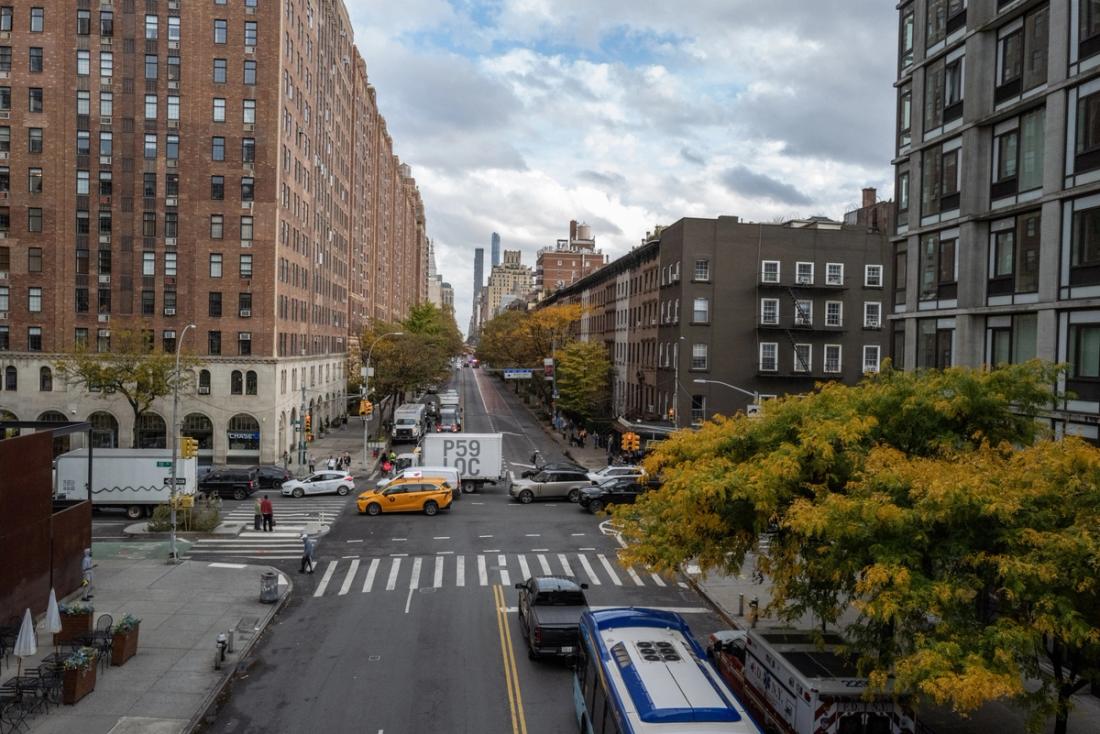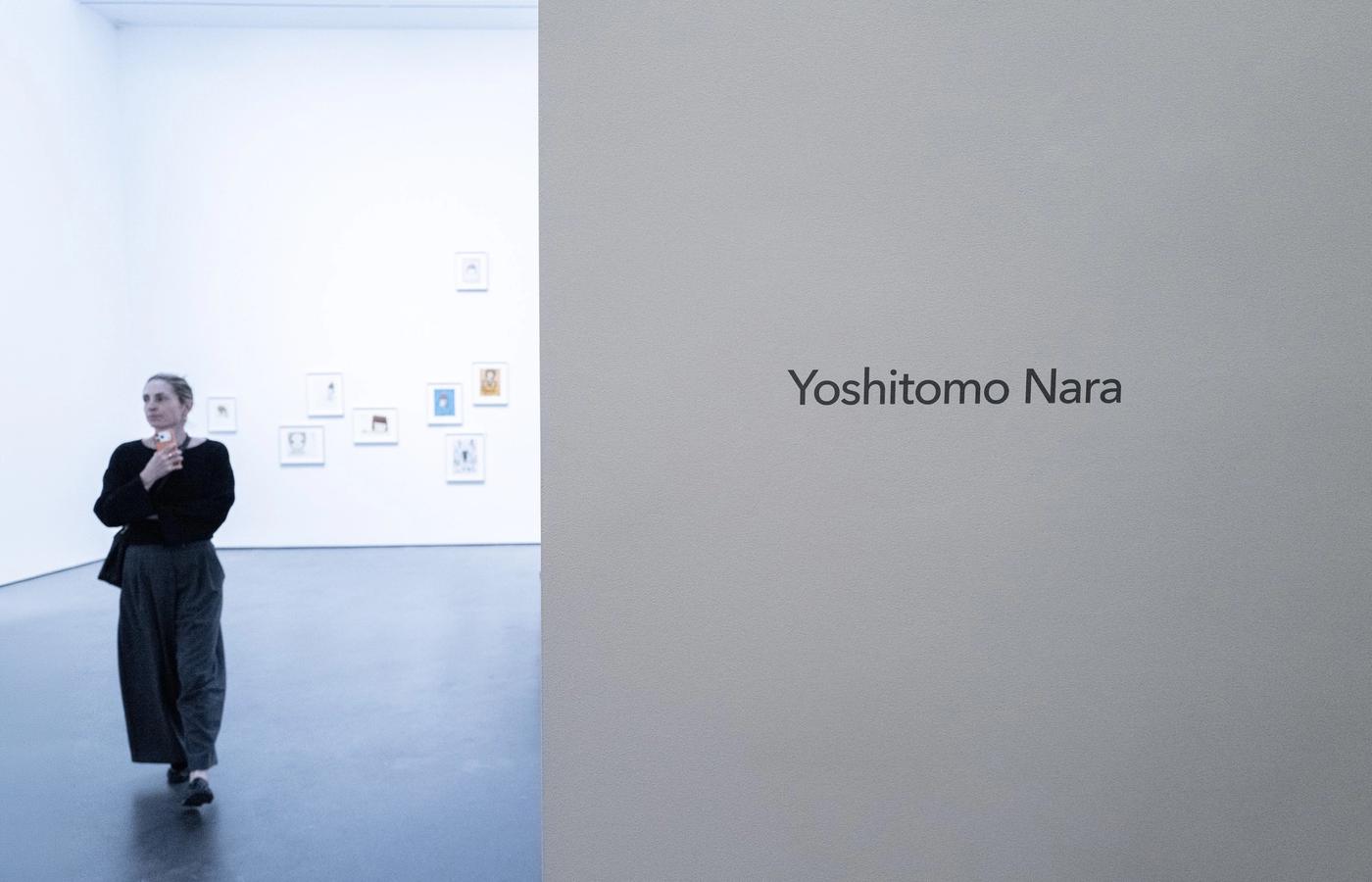
A solo exhibition by Japanese artist Yoshitomo Nara opened Thursday, Nov. 5, at David Zwirner in Chelsea. It is his first show since leaving Pace, his gallery of 14 years, and his first major solo exhibition in New York in nearly a decade.
A solo exhibition by Japanese artist Yoshitomo Nara opened Thursday, Nov. 5, at David Zwirner in Manhattan's Chelsea neighborhood. It is Nara's first show since he left Pace, the gallery he worked with for 14 years, for Zwirner, and his first major solo exhibition in New York in nearly a decade.
The show spans two galleries a block apart, at 537 West 20th Street and 533 West 19th Street. Nearly 100 works are on view: new paintings and drawings made this year, recent sculptures, and earlier works selected by the artist himself. It runs through Saturday, Dec. 12, and admission is free.
NY&NJ attended the press preview on the afternoon of the opening. In white rooms lit by skylights, only a few large faces hung on each wall, and visitors lingered in front of single paintings. Even the largest works were given generous wall space, setting up a one-on-one encounter with the children in the pictures.
From Pace to Zwirner: a move the art world watched
Zwirner announced on Monday, Nov. 3, 2025, that it would represent Nara's work. Nara had worked with Pace since 2011. Zwirner represents the artist together with Equivalence Art Agency, founded by Nara's international agent Joe Baptista, a former Pace partner.
Because a signature artist was moving between two of the world's top galleries, the switch drew wide attention. Pace CEO Marc Glimcher called the move "a little surprising" but said, "We are so proud of everything we have done for Yoshitomo Nara. Looking back on our 14 years of working together, we would not do anything differently." Pace said it will continue to have a relationship with the artist. Art market information firm Artprice said the closure last year of Blum, another of Nara's longtime galleries, accelerated the move.
Nara is also one of the market's top names. In October 2019 his 2000 painting "Knife Behind Back" sold at Sotheby's Hong Kong for about HK$195.7 million (about $25 million), setting his auction record. Zwirner also represents Japanese artists including Yayoi Kusama and On Kawara.
David Zwirner, born in 1964 in Cologne, Germany, is five years younger than Nara. At the time of the announcement he said he had first encountered Nara's work in his hometown of Cologne in the early 1990s, adding, "To me, Nara's work is not unlike a great song: personal, emotive, uncompromising, and open to experimentation." Nara said he felt fortunate to work with a gallerist who, "though born and raised in a different place, shares the same generation and the spirit of the era we both lived through—including its subcultures."
Aomori snow, a painting language found in Germany
Nara was born in 1959 in Aomori Prefecture, at the northern tip of Japan's main island. A so-called latchkey kid, he spent much of his childhood alone, in a rural region that Japan's rapid economic growth had yet to reach. Memories of snow-covered landscapes, and a connection with nature and all living things, remain present in his work, according to the gallery.
Music shaped him too. As a child Nara listened to folk, country and soul on the U.S. military's Far East Network radio. He did not understand the lyrics, but he was drawn to the rhythms, the melodies and the longing in the songs. The fantastical children's stories of Kenji Miyazawa also expanded his imagination.
After studying art in Japan, Nara moved to Germany in 1988 and entered the Kunstakademie Düsseldorf, where he studied under the painter A.R. Penck. He later moved to Cologne and spent 12 years in Germany in all. On Penck's advice he began to paint with the same freedom he used in drawing, and his famous children with large heads and wide-set eyes took shape during this period.
The 2011 Tōhoku earthquake and tsunami marked another turning point. When his home region was devastated, Nara reconsidered his role as an artist and launched community art projects with residents of the affected areas. When he returned to painting, his children's sharp stares had given way to calm, meditative faces.
20th Street: faces that blur and glow
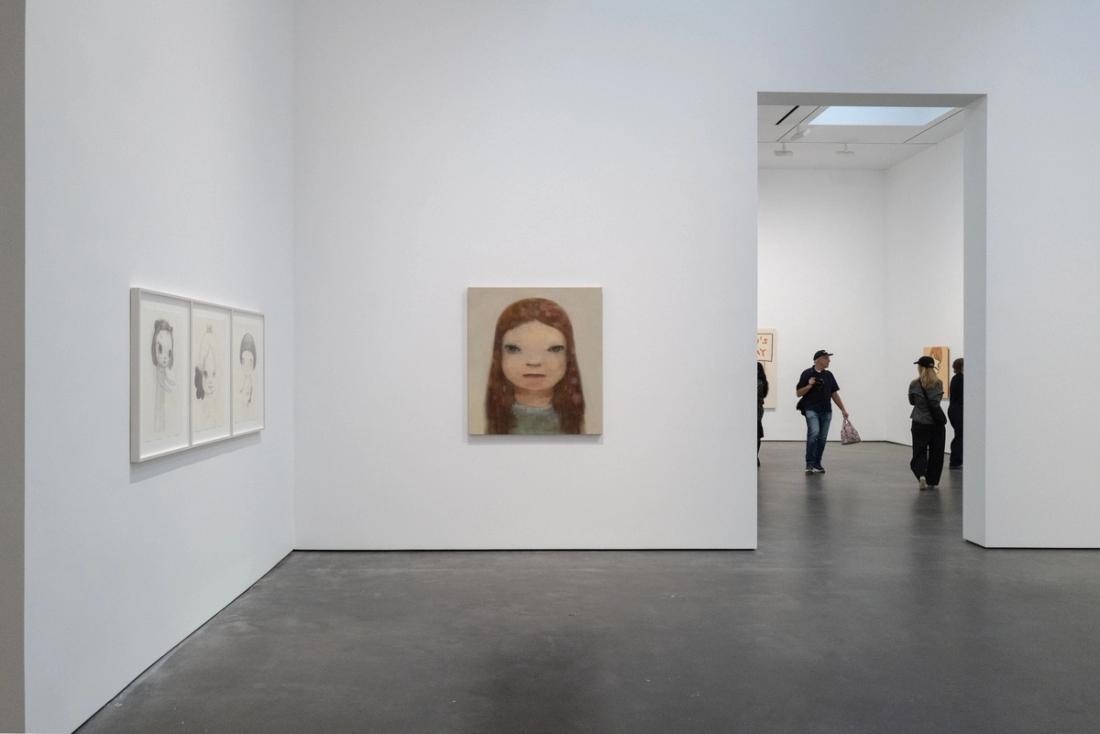
The heart of the 20th Street gallery is a group of new portraits. A child's face floats at the center of a large canvas. Outlines have all but disappeared, and layers of muted earth tones, pinks and pale greens build up until the face seems to emerge from mist. The gallery describes the color as achieving "a sense of humidity and luminosity." Nara applies paint and reworks it again and again, searching for what is essential.
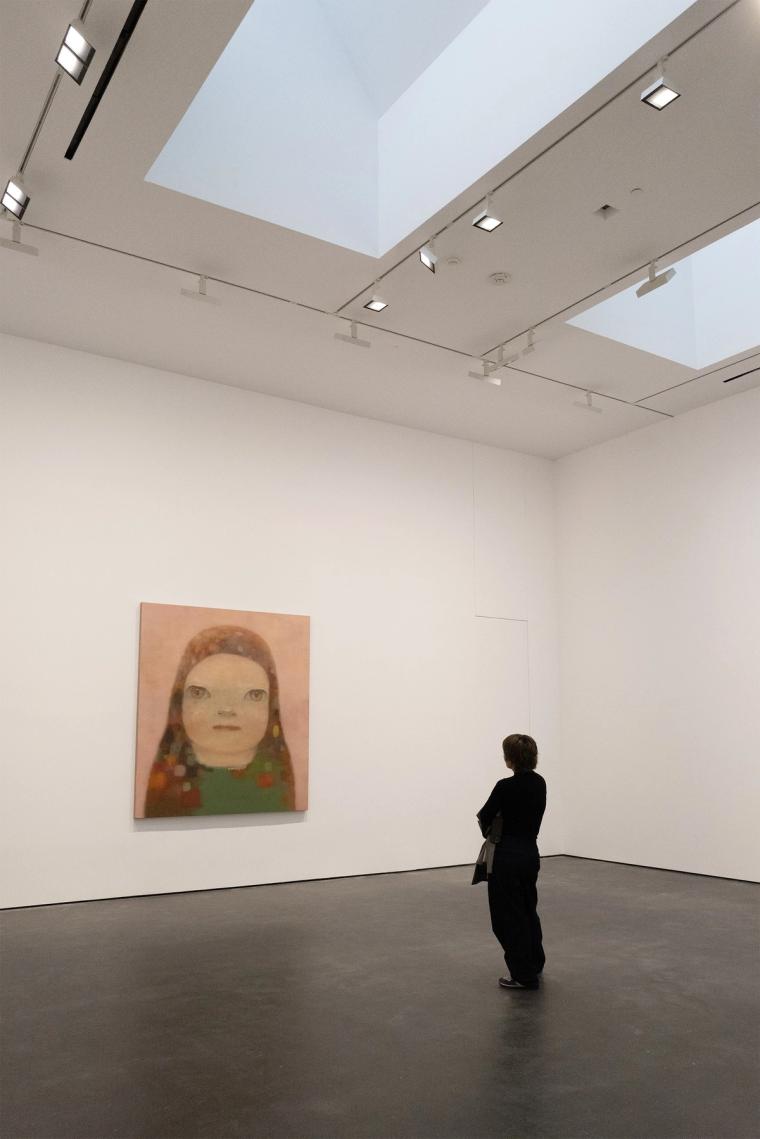
The materials are worth a close look. Many of the new works are painted not on canvas but on styrene boards and wood panels. Nara builds supports from materials he reuses from his studio and collages cut fabric, printed paper and corrugated cardboard from packing boxes onto them. Up close, the creases of the paper and ridges of the cardboard become part of the image.
Several works carry short phrases. Lines such as "RIVER SIDE," "TOMORROW'S FAR AWAY" and "DEAD LOCK" appear beside the children like song lyrics or something muttered to oneself, a characteristically Nara way of turning feelings drawn from music into pictures.
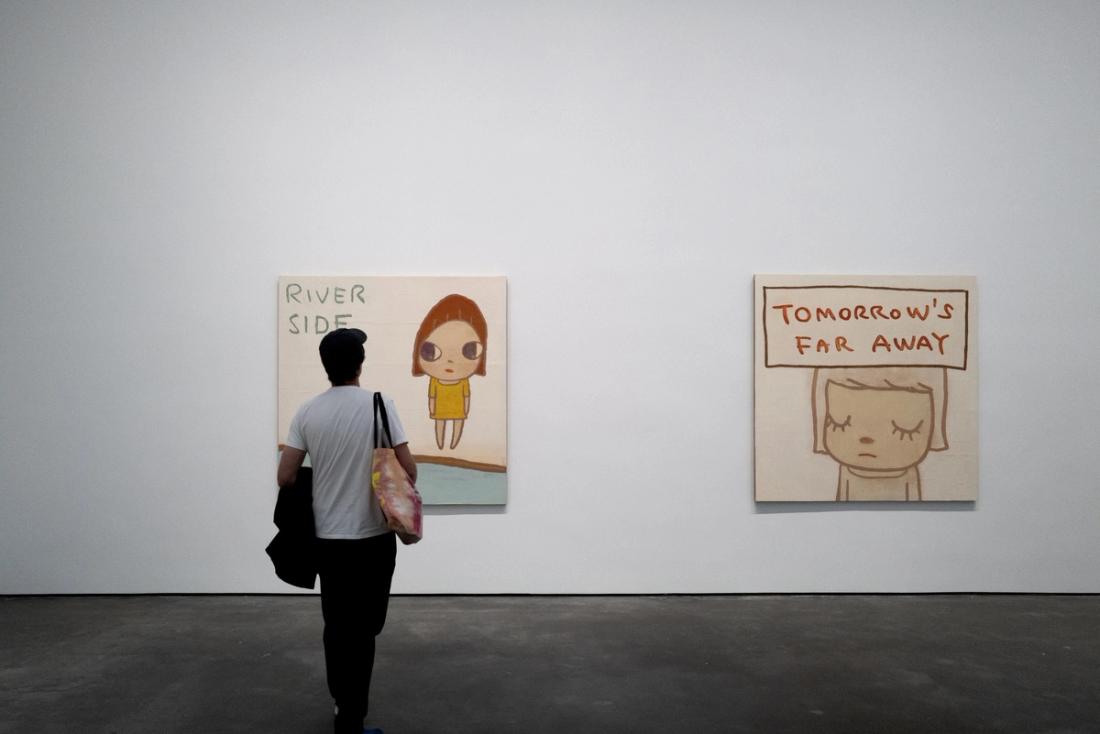
A child with closed eyes and a child staring straight ahead face each other across one room. The paintings hang far apart, so standing in the middle of the room feels like being watched by both faces at once.
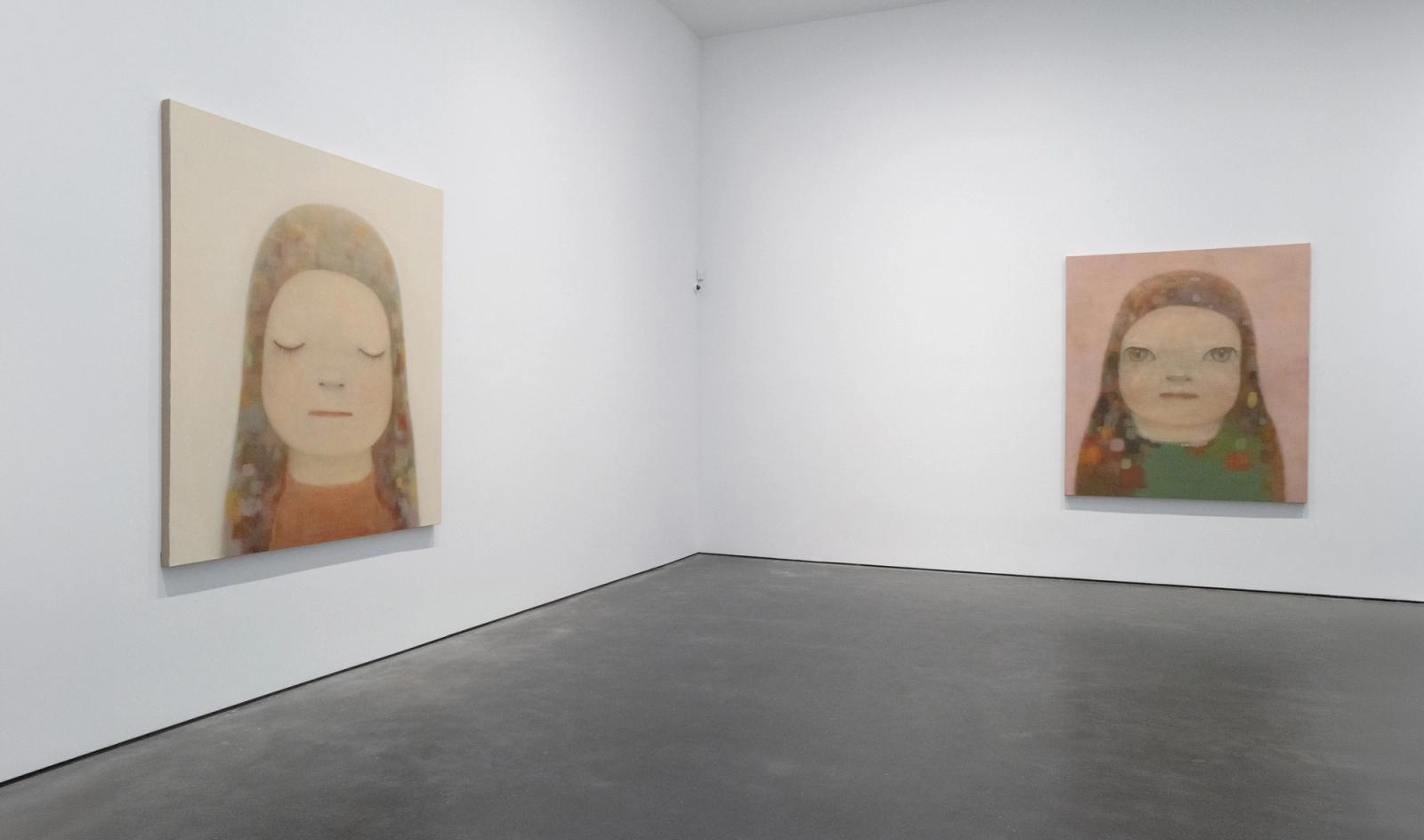
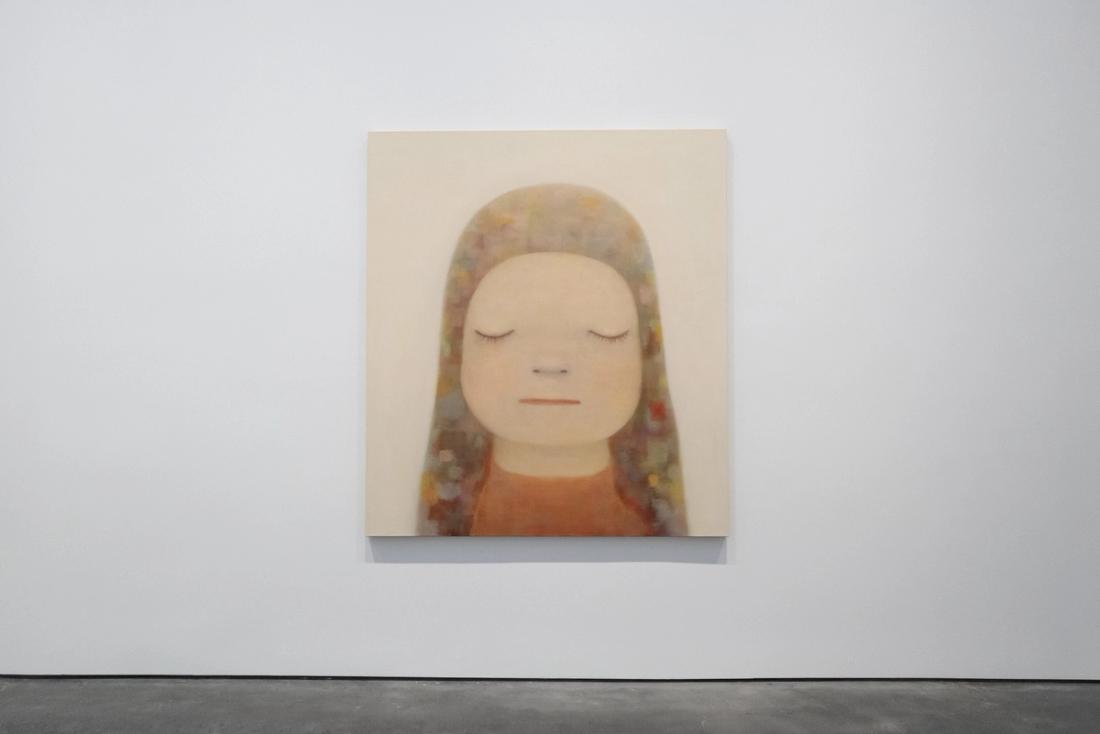
The painting that holds visitors longest is a portrait of a child with closed eyes. The hair is built from small dots of many colors that seem to bleed into one another, and the face glows with a soft light. It continues the meditative faces that have appeared in Nara's paintings since 2011.
In the next room, four large paintings of children, a house and small animals, drawn in fine lines on cream grounds, hang side by side. Equal in size and evenly spaced along a wide wall under the skylights, they read like four pages of a picture book laid open.
Earlier works chosen by the artist
Alongside the new work, like a mirror held up to it, are earlier drawings and paintings selected by Nara. According to the gallery, two drawings from 1988 show his first attempts to express his inner self. Works from the early 1990s in Germany, when he was developing his own pictorial language, are also on view.
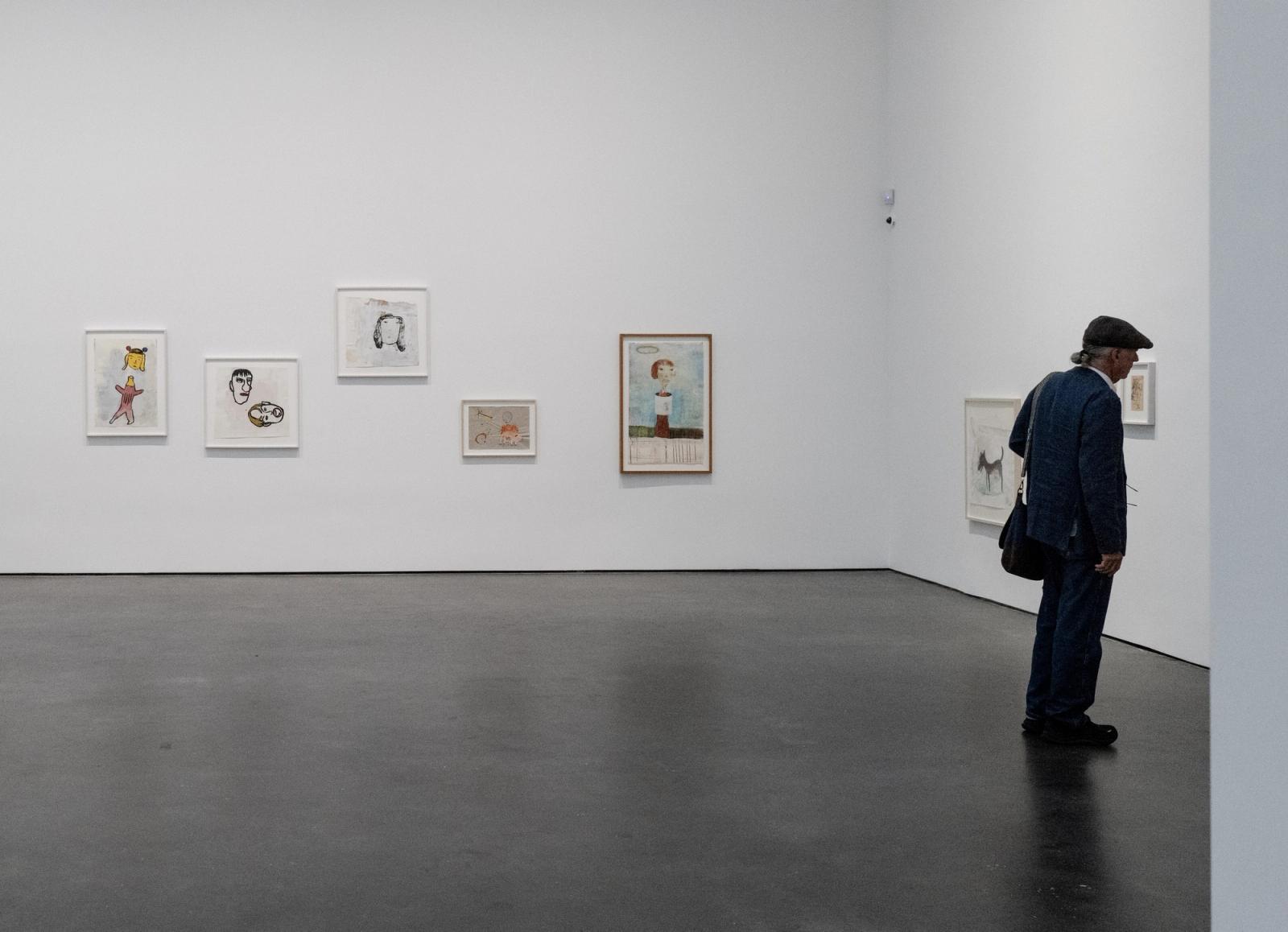
A wall of small framed drawings scattered across the surface feels like leafing through Nara's sketchbook. A child in a red cap, a child with a bob, a child on a blue ground fill the wall in different sizes and colors. Nearby hangs a large painting of a child grinning mischievously under a light bulb while holding a saw: the cute but somehow defiant child people picture when they think of Nara.
Large black-and-white drawings made this year
The mood changes sharply in a room with wooden floors. Large drawings in thick black lines on white paper run along the walls. According to the gallery, they are new works made this year with industrial oil-based paint sticks, drawn without hesitation from a melody or a line of lyrics in the music Nara was listening to.
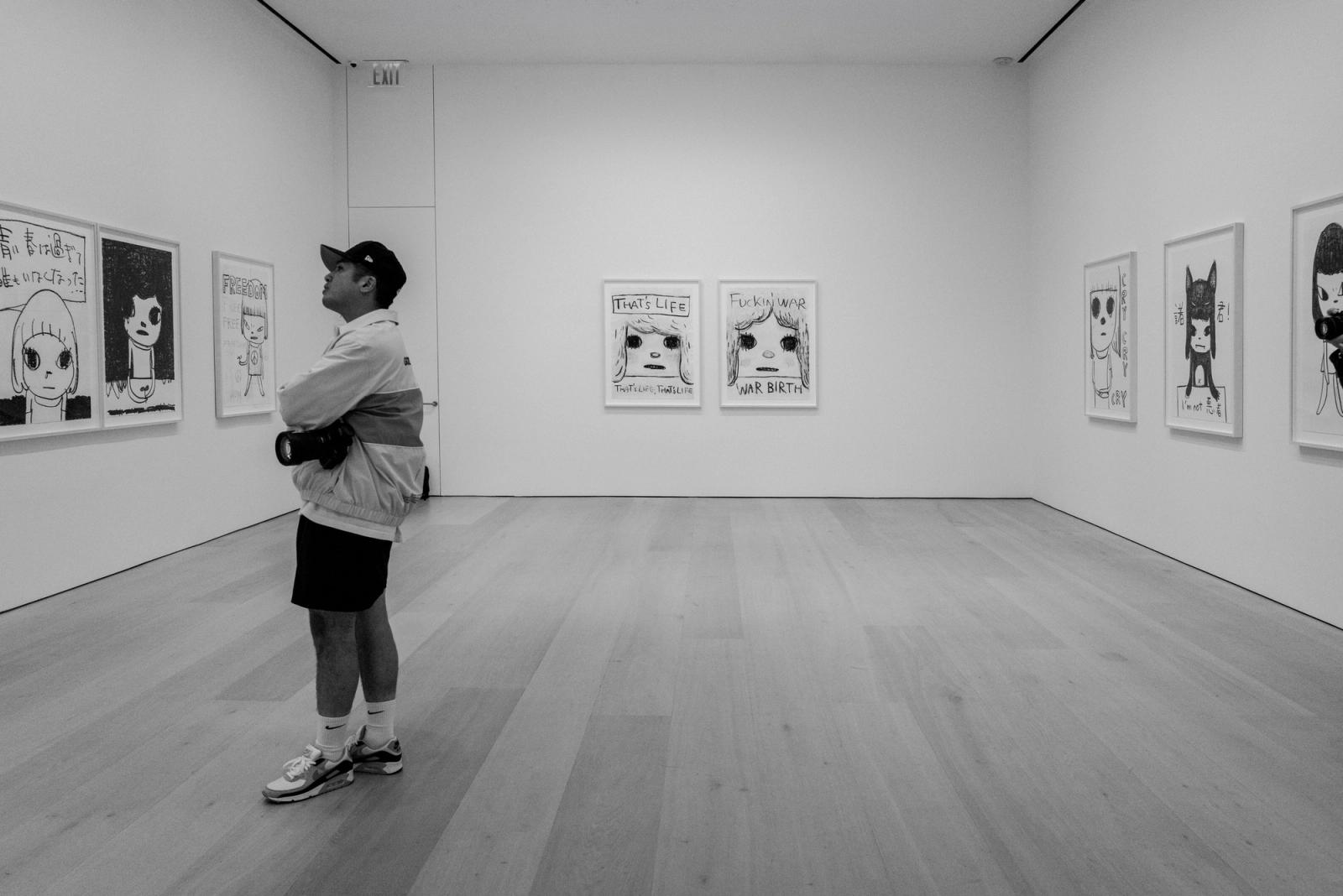
Each drawing carries words in large letters: English phrases such as "THAT'S LIFE," "WAR BIRTH," "CRY CRY CRY" and "Bang! Bang Bang Bang," and Japanese ones such as "悪夢の向こうへ" (Beyond the nightmare). Unlike the stillness of the color portraits, the children here stare wide-eyed, shout or point finger guns. Nara's long-running themes of war, sorrow and resistance come through most directly here.
19th Street: white heads like snow-covered forests
A block south, the 19th Street gallery holds 13 sculptures from 2024: monumental heads cast in bronze and coated in white urethane paint. The gallery says they recall the snow-covered forests of Mount Hakkōda, near the artist's hometown.
Drawing on ancient folk beliefs, Nara understands the natural world beneath the snow to possess a living soul, with tree speaking to mountain and water to stone. Standing like ancient monoliths, with light and shadow moving across their smooth surfaces, the heads create space for serenity and contemplation, according to the gallery. Walking from the paintings on 20th Street down to 19th Street lets visitors feel the contrast between the two spaces.
A year of Nara, from Washington to San Francisco
Last year Nara held a major retrospective at the Hayward Gallery in London. Running alongside the New York show, "Yoshitomo Nara: Sentinels of Stillness," featuring three monumental sculptures, is on view in the Hirshhorn Museum's Sculpture Garden in Washington, D.C., through Nov. 7, 2027. A major retrospective is scheduled to open at the San Francisco Museum of Modern Art (SFMOMA) in fall 2027.
The New York show is, in effect, the start of that year. The artist did not give press interviews in connection with the exhibition.
Visitor tips
The two galleries are a few minutes' walk apart. A natural route is to start at 20th Street and continue to the sculptures on 19th Street. The gallery bookshop has a full wall of Nara's books and catalogs, worth a browse.
The gallery website currently lists viewing hours of 10 a.m. to 6 p.m. on Fridays and Saturdays. Check the website before visiting for days and hours from next week on. Chelsea's gallery district is close to the High Line, making it easy to pair the show with a late-fall walk.